Chronology is the arrangement of events in the order in which they happened. It provides the framework historians need to compare societies, identify change and investigate causes. A date locates an event, but historical explanation goes further: it asks how that event was connected to the circumstances before and after it.

Ordering and explaining the past
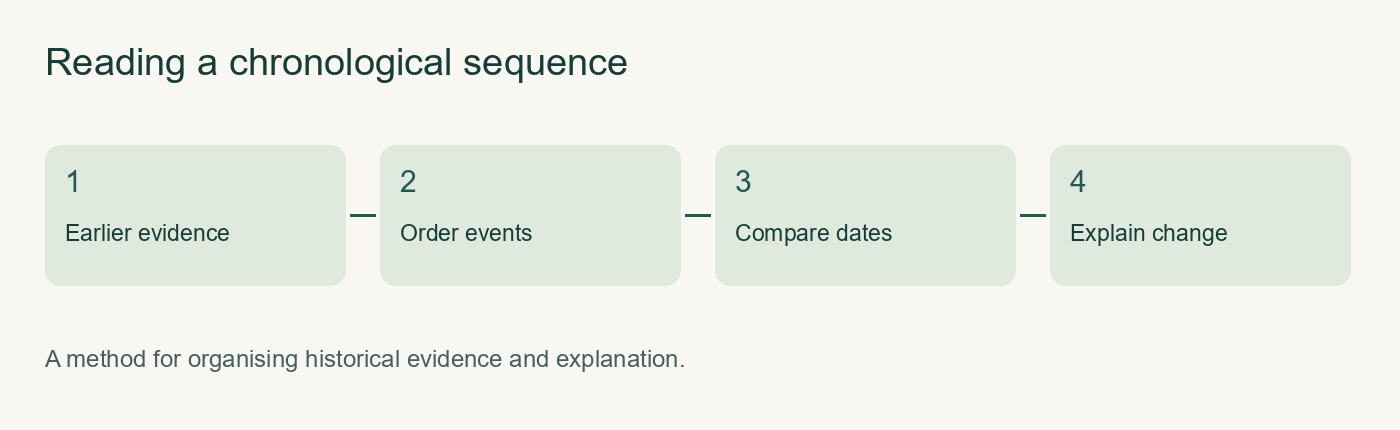
A chronological account moves from earlier events to later ones. Events can also be simultaneous: different societies may experience different developments during the same period. Historians therefore compare both sequences within a society and connections between societies.
This distinction matters when explaining causes. An event that happened first did not necessarily cause everything that followed. To establish a connection, historians examine evidence of decisions, actions and conditions. Chronology makes an explanation possible; it does not replace the evidence supporting it.
BCE, CE and the absence of a year zero
BCE means “Before Common Era”, while CE means “Common Era”. The same year numbering is also expressed as BC, “Before Christ”, and AD, from the Latin Anno Domini. The AD system was devised by the monk Dionysius Exiguus in 525 CE using an estimate of the year of Jesus’s birth. The two pairs of labels identify the same dates.
BCE dates become smaller as they approach the beginning of the Common Era. Thus 400 BCE is earlier than 300 BCE. CE dates increase as time passes, so 50 CE is earlier than 120 CE. In the historical convention, 1 BCE is followed directly by 1 CE: there is no year zero.
To calculate the interval between corresponding points in two years within the same era, subtract the smaller year number from the larger. Across the BCE-CE boundary, add the numbers and subtract one. The interval from 27 BCE to 476 CE is therefore 502 years, while 753 BCE to 202 BCE spans 551 years. Exact intervals between particular events also depend on their months and days.
Centuries and millennia
A decade contains ten years, a century one hundred and a millennium one thousand. The first century CE runs from 1 to 100, the second from 101 to 200, and the fourth from 301 to 400. This explains why 350 CE belongs to the fourth century rather than the third.
For a positive year number, dividing by one hundred and rounding upwards identifies the century. An exact multiple of one hundred closes a century: 2000 CE ends the twentieth century, and 2001 begins the twenty-first. The fifth century BCE runs from 500 to 401 BCE, so 450 BCE belongs to it. Similarly, 44 BCE is in the first century BCE, while 1789 CE is in the eighteenth century CE.
Millennia follow the same principle. The first millennium CE contains years 1-1000, the second 1001-2000 and the third 2001-3000. Consequently, 2026 CE belongs to the third millennium. The first millennium BCE runs from 1000 BCE to 1 BCE.
How people recorded numbers
Counting existed long before modern numerals. Prehistoric people made marks on objects, and communities in Mesopotamia used clay tokens and tablets to record goods. The exact purpose of an individual prehistoric object can be uncertain. Mesopotamian mathematical traditions included counting based on sixty, a legacy reflected in our division of hours and angles.
The Hindu-Arabic numeral system developed over centuries from Indian mathematical traditions and was transmitted and developed by scholars in the Islamic world. Its decimal place-value structure makes the position of a digit significant: the 1 in 15, 105 and 1500 has a different value. Zero marks an empty position and can also function as a number. Brahmagupta discussed calculation with zero in 628 CE; al-Khwarizmi worked in the ninth century, and Fibonacci’s Liber Abaci helped spread these methods in Europe from 1202.
Reading Roman numerals and historical dates
Roman numerals use seven principal symbols: I for 1, V for 5, X for 10, L for 50, C for 100, D for 500 and M for 1000. A smaller symbol after a larger one normally adds to it, as in VI, or 6. Standard subtractive combinations include IV, or 4, IX, or 9, and XL, or 40. Historical inscriptions and clocks sometimes use different conventions.
MMXXVI represents 2026, while MCMLXIX represents 1969. Once a numeral has been converted, its date can be placed alongside dates written in other forms. Consistent labels, a clear direction from earlier to later, and an appropriate scale make a historical timeline understandable. The aim is to reveal relationships between events, not merely to display an isolated succession of numbers.
Revision questions
Write an answer before opening the explanation. Your answers stay in this browser.
01 Why does chronology help historians explain events rather than merely list them?
Read the explanation
This distinction matters when explaining causes. An event that happened first did not necessarily cause everything that followed. To establish a connection, historians examine evidence of decisions, actions and conditions. Chronology makes an explanation possible; it does not replace the evidence supporting it.
02 How are BCE and CE dates ordered, and why does the absence of a year zero matter?
Read the explanation
BCE dates become smaller as they approach the beginning of the Common Era. Thus 400 BCE is earlier than 300 BCE. CE dates increase as time passes, so 50 CE is earlier than 120 CE. In the historical convention, 1 BCE is followed directly by 1 CE: there is no year zero.
To calculate the interval between corresponding points in two years within the same era, subtract the smaller year number from the larger. Across the BCE-CE boundary, add the numbers and subtract one. The interval from 27 BCE to 476 CE is therefore 502 years, while 753 BCE to 202 BCE spans 551 years. Exact intervals between particular events also depend on their months and days.
03 Explain how centuries and millennia are counted, using a dated example.
Read the explanation
For a positive year number, dividing by one hundred and rounding upwards identifies the century. An exact multiple of one hundred closes a century: 2000 CE ends the twentieth century, and 2001 begins the twenty-first. The fifth century BCE runs from 500 to 401 BCE, so 450 BCE belongs to it. Similarly, 44 BCE is in the first century BCE, while 1789 CE is in the eighteenth century CE.
Millennia follow the same principle. The first millennium CE contains years 1-1000, the second 1001-2000 and the third 2001-3000. Consequently, 2026 CE belongs to the third millennium. The first millennium BCE runs from 1000 BCE to 1 BCE.
04 How do Roman numerals combine symbols? Give an example.
Read the explanation
MMXXVI represents 2026, while MCMLXIX represents 1969. Once a numeral has been converted, its date can be placed alongside dates written in other forms. Consistent labels, a clear direction from earlier to later, and an appropriate scale make a historical timeline understandable. The aim is to reveal relationships between events, not merely to display an isolated succession of numbers.