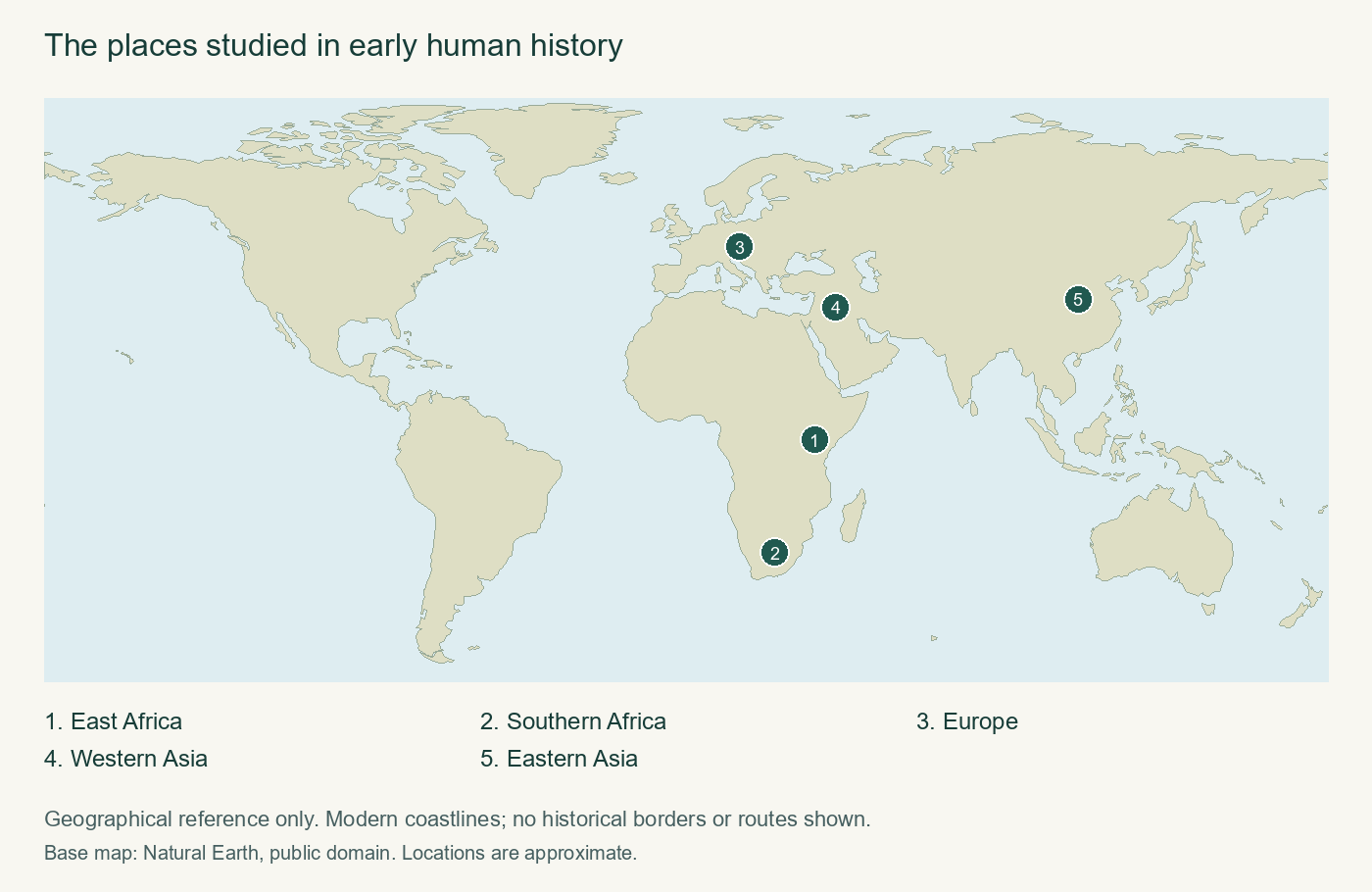
Human origins are studied through fossils, archaeological objects and genetic evidence. These sources show that the human family emerged in Africa and developed through a branching evolutionary history. Several related species existed at the same time; the process was not a simple ladder leading inevitably to modern humans. Today all living people belong to one species, Homo sapiens.

Africa and the earliest hominins
Hominins belong to the evolutionary branch that includes humans and our extinct relatives after the separation from the lineage of chimpanzees. Africa contains important evidence of their early history. Toumaï, a skull of Sahelanthropus tchadensis discovered in Chad in 2001, dates to about seven million years ago. Its place in human evolution and aspects of its movement have been debated, illustrating how scientific interpretations develop as evidence is examined.
Lucy, discovered at Hadar in Ethiopia in 1974, belonged to Australopithecus afarensis and lived about 3.2 million years ago. Around forty per cent of her skeleton survived. Her anatomy indicates upright walking as well as adaptations associated with climbing. Fossils such as these help researchers reconstruct bodies and movement, although they cannot reveal every aspect of an individual’s life.
Different species and the Old Stone Age
The Palaeolithic, or Old Stone Age, covers the long period in which stone tools formed an important part of human technology before the spread of farming. Its beginning and end depend on the region and the evidence being discussed. Tools about 3.3 million years old from Kenya show that stone-working cannot simply be attributed to Homo habilis as a single invention.
Homo habilis, early Homo erectus, Neanderthals and Homo sapiens differed in their anatomy and lived over overlapping periods. Homo erectus had a body well suited to walking long distances. Neanderthals inhabited Europe and western Asia and developed sophisticated hunting and tool-making practices. Homo sapiens emerged in Africa about 300,000 years ago. The last Neanderthals disappeared around 40,000 years ago, but the history of interactions between populations was more complex than a straightforward replacement.
Control of fire changed daily life by providing heat, light and opportunities to cook. It developed over a long period, and the evidence does not justify treating one date as the moment when every human group mastered it. Stone tools likewise changed gradually: hand axes worked on both faces were joined by specialised blades, points and tools made from bone or antler.
Migrations beyond Africa
Human expansion beyond Africa occurred in several waves. At Dmanisi in present-day Georgia, skulls, tools and animal remains document early humans living outside Africa about 1.8 million years ago. These finds are commonly associated with early Homo erectus and provide a major reference point for studying migration.
Much later, Homo sapiens expanded across Eurasia and into Australia. Major dispersals occurred tens of thousands of years ago, with movement into Australia involving sea crossings. During ice ages, lower sea levels exposed land that is now submerged. A land connection between Siberia and Alaska helped make movement into the Americas possible, although the dates and routes of the earliest settlement remain subjects of research. Human presence there predates a simple fixed arrival date of 15,000 years ago.
These migrations were not single journeys planned across a world map. Populations moved, settled, divided and moved again over many generations. Climate, available food, social relationships and technological knowledge shaped their choices. Pacific islands were settled through later maritime movements; Antarctica did not acquire a prehistoric resident population.
Hunter-gatherer life
Palaeolithic communities obtained food by hunting, fishing and collecting wild plants, nuts, roots and fruit. Many moved seasonally, but their mobility varied with local resources. “Nomadic” therefore describes a pattern of movement rather than a universal way of life shared identically by every prehistoric group.
People used open-air camps, tents and rock shelters. At Pincevent in France, hearths and objects help archaeologists reconstruct the organisation of camps used by reindeer hunters around 12,000 years ago. Such reconstructions are interpretations based on material traces, not surviving photographs of the settlement. Cave entrances could offer shelter, but the familiar image of all prehistoric people living deep inside caves is misleading.
Art and the interpretation of beliefs
Surviving artworks include small sculptures, engravings and cave paintings. The limestone figure from Willendorf, about 30,000 years old, and the ivory face from Brassempouy, about 25,000 years old, demonstrate careful work with different materials. Hand stencils at Gargas were produced by applying pigment around a hand placed against a wall. At Lascaux, paintings show animals including horses, deer and aurochs.
These objects provide evidence of observation, skill and symbolic expression. Their exact meanings are harder to establish: a figure may have had religious, social or personal significance, but appearance alone does not prove its function. Studying prehistory therefore requires both imagination and restraint, separating what the evidence shows from what remains a plausible interpretation.
Revision questions
Write an answer before opening the explanation. Your answers stay in this browser.
01 What evidence supports the African origins of humanity?
Read the explanation
Lucy, discovered at Hadar in Ethiopia in 1974, belonged to Australopithecus afarensis and lived about 3.2 million years ago. Around forty per cent of her skeleton survived. Her anatomy indicates upright walking as well as adaptations associated with climbing. Fossils such as these help researchers reconstruct bodies and movement, although they cannot reveal every aspect of an individual’s life.
02 Why is human evolution better understood as branching than as a straight line?
Read the explanation
Homo habilis, early Homo erectus, Neanderthals and Homo sapiens differed in their anatomy and lived over overlapping periods. Homo erectus had a body well suited to walking long distances. Neanderthals inhabited Europe and western Asia and developed sophisticated hunting and tool-making practices. Homo sapiens emerged in Africa about 300,000 years ago. The last Neanderthals disappeared around 40,000 years ago, but the history of interactions between populations was more complex than a straightforward replacement.
Control of fire changed daily life by providing heat, light and opportunities to cook. It developed over a long period, and the evidence does not justify treating one date as the moment when every human group mastered it. Stone tools likewise changed gradually: hand axes worked on both faces were joined by specialised blades, points and tools made from bone or antler.
03 How did hunter-gatherers obtain food and organise their movements?
Read the explanation
People used open-air camps, tents and rock shelters. At Pincevent in France, hearths and objects help archaeologists reconstruct the organisation of camps used by reindeer hunters around 12,000 years ago. Such reconstructions are interpretations based on material traces, not surviving photographs of the settlement. Cave entrances could offer shelter, but the familiar image of all prehistoric people living deep inside caves is misleading.
04 What can prehistoric art reveal, and what remains uncertain?
Read the explanation
These objects provide evidence of observation, skill and symbolic expression. Their exact meanings are harder to establish: a figure may have had religious, social or personal significance, but appearance alone does not prove its function. Studying prehistory therefore requires both imagination and restraint, separating what the evidence shows from what remains a plausible interpretation.