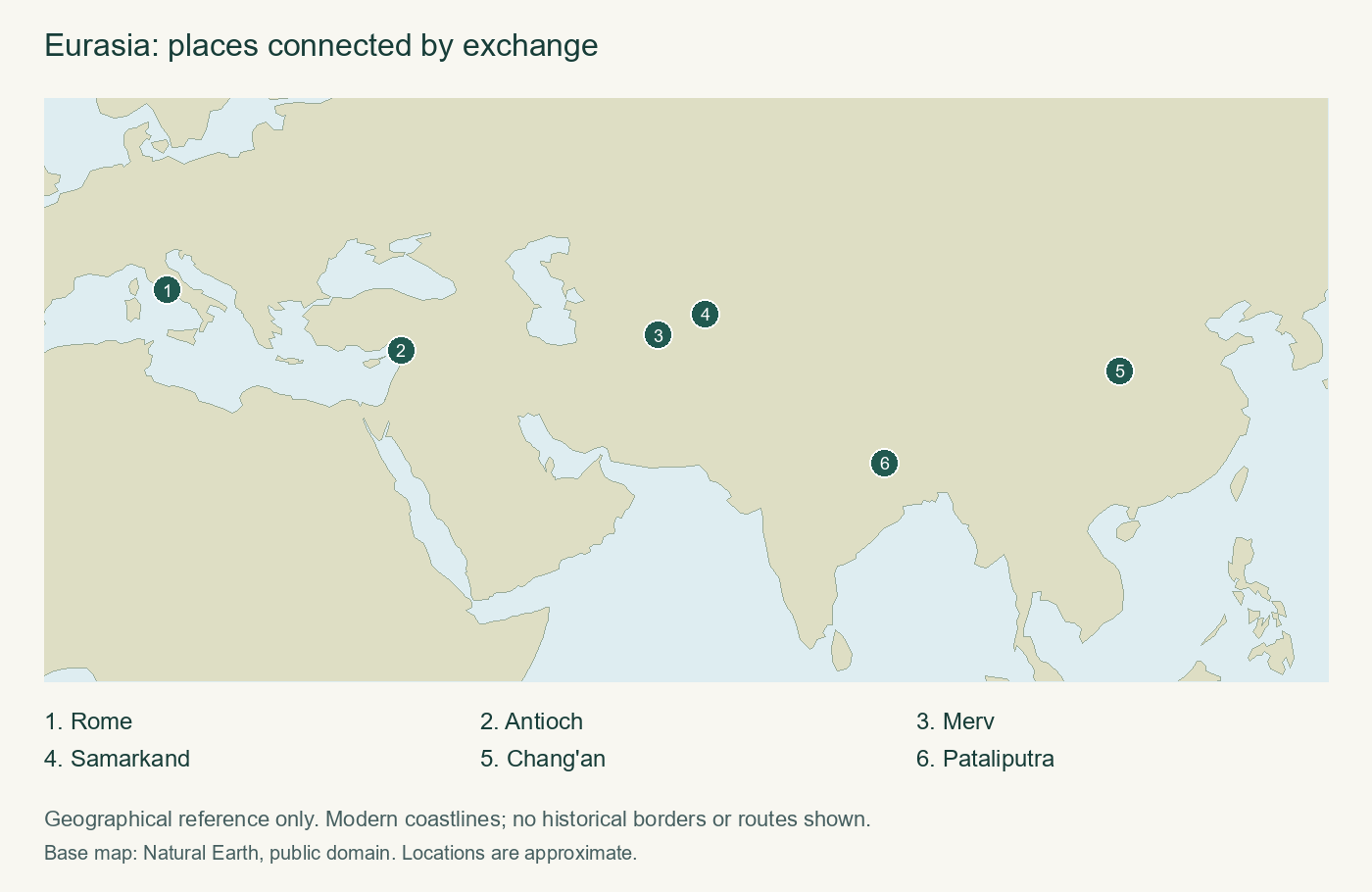
The Roman Empire was part of a much wider ancient world. Beyond its eastern frontiers lay powerful states and trading networks that connected the Mediterranean with Central Asia, India and China. The term Silk Roads describes these interconnected routes rather than a single road. Goods, techniques and religious ideas travelled through them, usually by passing between many different communities.
Two empires at opposite ends of Eurasia
While Rome expanded around the Mediterranean, major political changes transformed China. The Qin ruler unified several competing kingdoms in 221 BCE and adopted the title of emperor. His government standardised important features of administration, including systems of weights and measures and forms of writing. The Qin dynasty was short-lived, but imperial unification had lasting consequences.
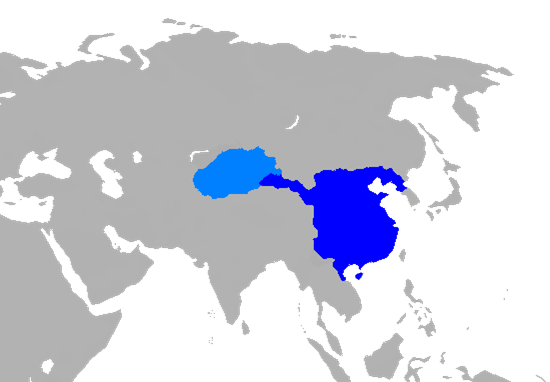
The Han dynasty ruled from 206 BCE to 220 CE, with an interruption associated with Wang Mang's rule and the subsequent restoration. Its territories and authority varied over this long period. Emperor Wudi, who reigned from 141 to 87 BCE, expanded Han power and supported expeditions and diplomatic contacts toward Central Asia.
Rome and Han China therefore existed at roughly the same time without sharing a frontier. Between them lay states such as the Parthian Empire and the Kushan Empire. These societies were active participants in exchange, not empty spaces crossed by Roman or Chinese travellers.
How long-distance trade worked
Overland routes crossed mountains, deserts and oases. Caravans needed water, food, animals, guides and access to markets. Most merchants travelled only part of the distance; a product could change hands repeatedly before reaching its final buyer. Political protection, local agreements and the security of passes and settlements affected the cost and reliability of trade.
Maritime networks also linked the Roman world with the Indian Ocean. Goods moved through Red Sea ports and across seas where knowledge of seasonal monsoon winds helped sailors plan voyages. Overland and sea routes complemented one another. The network changed over time as political conditions and commercial opportunities changed.
Calling these connections Silk Roads is convenient, but it can be misleading if it suggests a single route managed by one state. The phrase is a modern name for diverse and shifting networks. Direct contact between Roman and Chinese rulers was limited; most exchange depended on intermediaries.
Silk and other traded goods
Silk was produced from fibres obtained from silkworm cocoons. Raising silkworms, feeding them mulberry leaves and processing the thread required specialised knowledge and labour. Silk fabrics became highly valued luxury goods far from their places of production. In Rome, they were associated with wealth and attracted moral criticism because of their expense.
The networks carried much more than silk. Spices, aromatic substances, precious stones, textiles, glass and metal objects moved through different regions. It is important not to label every eastern luxury as Chinese: India, Arabia, Central Asia and other regions supplied their own products. Objects found far from where they were made reveal connections, but do not always identify the exact merchants or route involved.
Exchange also affected culture. Religious ideas, artistic styles and practical knowledge could travel with people and goods. Buddhism, for example, spread into China through networks connecting it with Central and South Asia. Cultural transmission involved translation and adaptation, rather than the simple copying of an unchanged idea.
Government and society under the Han
Han emperors governed through officials who collected information, organised taxation and maintained imperial authority. Educated officials increasingly studied Confucian traditions, which emphasised moral conduct, social relationships and responsible government. This did not mean that the fully developed examination system of later imperial China already existed in the Han period.
Farming supported the population and the state, while workshops produced sophisticated metalwork, lacquerware, textiles and other goods. Archaeological finds from tombs reveal differences in wealth, beliefs about the afterlife and considerable technical skill. The surviving objects often come from elite burials, so they should not be assumed to represent every household.
Papermaking developed in China during the Han period; the official Cai Lun is traditionally associated with improvements reported in 105 CE, rather than the invention of all paper from nothing. Other technologies also had long and complex histories. A later illustration of silk production can explain a technique, but it is not direct visual evidence of a Han workshop. Careful dating of sources is therefore as important as locating them on a map.
Revision questions
Write an answer before opening the explanation. Your answers stay in this browser.
01 Why were Rome and Han China connected without sharing a frontier?
Read the explanation
The Han dynasty ruled from 206 BCE to 220 CE, with an interruption associated with Wang Mang's rule and the subsequent restoration. Its territories and authority varied over this long period. Emperor Wudi, who reigned from 141 to 87 BCE, expanded Han power and supported expeditions and diplomatic contacts toward Central Asia.
Rome and Han China therefore existed at roughly the same time without sharing a frontier. Between them lay states such as the Parthian Empire and the Kushan Empire. These societies were active participants in exchange, not empty spaces crossed by Roman or Chinese travellers.
02 Why is the expression Silk Roads more accurate than the idea of a single road?
Read the explanation
Maritime networks also linked the Roman world with the Indian Ocean. Goods moved through Red Sea ports and across seas where knowledge of seasonal monsoon winds helped sailors plan voyages. Overland and sea routes complemented one another. The network changed over time as political conditions and commercial opportunities changed.
Calling these connections Silk Roads is convenient, but it can be misleading if it suggests a single route managed by one state. The phrase is a modern name for diverse and shifting networks. Direct contact between Roman and Chinese rulers was limited; most exchange depended on intermediaries.
03 What travelled through these networks besides silk?
Read the explanation
The networks carried much more than silk. Spices, aromatic substances, precious stones, textiles, glass and metal objects moved through different regions. It is important not to label every eastern luxury as Chinese: India, Arabia, Central Asia and other regions supplied their own products. Objects found far from where they were made reveal connections, but do not always identify the exact merchants or route involved.
Exchange also affected culture. Religious ideas, artistic styles and practical knowledge could travel with people and goods. Buddhism, for example, spread into China through networks connecting it with Central and South Asia. Cultural transmission involved translation and adaptation, rather than the simple copying of an unchanged idea.
04 What do officials, crafts and tombs reveal about Han society?
Read the explanation
Farming supported the population and the state, while workshops produced sophisticated metalwork, lacquerware, textiles and other goods. Archaeological finds from tombs reveal differences in wealth, beliefs about the afterlife and considerable technical skill. The surviving objects often come from elite burials, so they should not be assumed to represent every household.
Papermaking developed in China during the Han period; the official Cai Lun is traditionally associated with improvements reported in 105 CE, rather than the invention of all paper from nothing. Other technologies also had long and complex histories. A later illustration of silk production can explain a technique, but it is not direct visual evidence of a Han workshop. Careful dating of sources is therefore as important as locating them on a map.