The development of farming, permanent settlements and cities was a long series of overlapping changes. People did not suddenly abandon a simple life and become “civilised”. Hunter-gatherers already possessed complex knowledge, technologies and social relationships. Archaeological evidence from Southwest Asia shows that settlement, cultivation, domestication, ritual and political organisation each followed their own history.
What makes a society complex?
Historians often associate complex societies with specialised occupations, administrative institutions, social inequalities, dense settlements and record keeping. These features did not appear together everywhere. A large village was not necessarily a city, and a community without writing was not necessarily without sophisticated beliefs or organisation.
The term “civilisation” must therefore be used carefully. It describes certain historical forms of social organisation rather than a scale of human worth. Societies based on hunting and gathering continued alongside farming communities and states, sometimes exchanging goods and knowledge with them.
The changing environment of the Ice Age
During the Last Glacial Maximum, approximately 26,500-19,000 years ago, extensive ice sheets covered northern Europe and North America. Sea level was about 120-130 metres lower than today. Britain was connected to continental Europe through Doggerland, Australia and New Guinea formed the larger landmass of Sahul, and exposed areas of Southeast Asia formed Sundaland. These landscapes offered routes and habitats that later disappeared beneath rising seas.
Warming after the glacial maximum was interrupted by climatic reversals. The Younger Dryas, about 12,900-11,700 years ago, brought especially marked cooling around the North Atlantic. Effects in Southwest Asia differed by locality. Climate altered the distribution of plants and animals, creating pressures and opportunities, but did not force every community to respond in the same way.
Dates expressed as BP, “before present”, conventionally count backwards from 1950 in archaeological dating. They should not be read as BCE dates. Regional period names also require care: the Epipalaeolithic and the Neolithic describe developments that did not begin simultaneously across the world.
Technology and symbolic life before farming
Palaeolithic communities used diverse diets rather than relying only on large game. Fish, shellfish, birds, small mammals, seeds, nuts and tubers could all be important. Microliths, small stone pieces fitted into composite tools, allowed specialised equipment. Grinding stones and plant residues demonstrate intensive food processing before agriculture.
In Europe, Aurignacian traditions appeared around 43,000-42,000 years ago and included carefully made blades and bone or antler points. Ornaments and artworks demonstrate symbolic expression. Chauvet’s paintings, including representations of large predators, date to around 36,000 years ago. Such examples show that neither farming nor cities were prerequisites for artistic achievement. Interpreting a figurine as a fertility symbol, however, remains a hypothesis rather than a fact established by its shape alone.
Cultivation, domestication and settlement
Cultivation means deliberately growing and managing plants. Domestication refers to biological changes in plants or animals over generations of human management. A community could sow wild cereals before its crops developed domesticated characteristics, such as retaining seeds on the stalk. It could also manage herds while continuing to hunt.
Sedentism means remaining in one place for long periods or permanently. It did not invariably follow farming: rich wild resources could support extended settlement. Dogs were domesticated before agriculture, while specialised uses of other animals, such as intensive wool production, developed later. These different sequences explain why farming is better understood as a spectrum of practices than as a single invention.
Ohalo II and early social networks
Ohalo II, beside the Sea of Galilee, dates to roughly 23,500-22,500 years ago. Six brush huts, hearths, bedding and abundant organic remains survived after burning and burial beneath lake sediments. Fish, animal bones and around 150,000 seeds and fruits reveal the use of many resources, including wild cereals. Seasonal evidence suggests prolonged or repeated occupation.
Some researchers interpret plant remains as evidence of trial cultivation, but the community was not a fully agricultural village. The distinction between secure findings and interpretation is essential. At Kharaneh IV in eastern Jordan, repeated gatherings around 20,000 years ago left dense concentrations of tools, ornaments and ochre. Marine shells far inland indicate connections extending well beyond a single settlement.
Natufian communities and the processing of food
Natufian communities occupied much of the southern Levant approximately 15,000-11,500 years ago. Some built circular structures on stone foundations and invested heavily in plant processing while hunting gazelle and other animals. Sites such as el-Wad, Hayonim and Raqefet demonstrate increasingly settled life without fully developed agriculture.
At Shubayqa 1 in Jordan, bread-like remains about 14,400 years old were made using wild plants. Producing them required grinding, mixing and heating ingredients. Residues from Raqefet have been interpreted as evidence for a fermented cereal preparation. These discoveries show sophisticated food production, but do not prove that making beer caused farming.
Burials also reveal social and ritual life. An unusually elaborate grave at Hilazon Tachtit contained numerous animal remains and other objects. The proposal that the woman buried there was a ritual specialist is an interpretation of the evidence. At Abu Hureyra, outside the main Natufian area, intensive plant use and changing settlement patterns likewise illuminate adaptation; claims about very early rye cultivation remain debated. The chronology of the Zarzian traditions in the Zagros is also less certain than a simple sequence suggests.
Early Neolithic villages and communal work
In parts of the Levant and Upper Mesopotamia, the Pre-Pottery Neolithic began around 9700-9600 BCE. Its earlier and later phases are called PPNA and PPNB, with a transition around 8800 BCE in many accounts. Communities increasingly cultivated plants and managed animals while maintaining hunting and gathering.
At Jerf el Ahmar, large shared buildings, food-processing areas and storage indicate organised communal activity. Wadi Faynan 16 also preserves substantial communal architecture. These buildings required cooperation, yet their existence alone does not prove that a powerful king directed the workers.
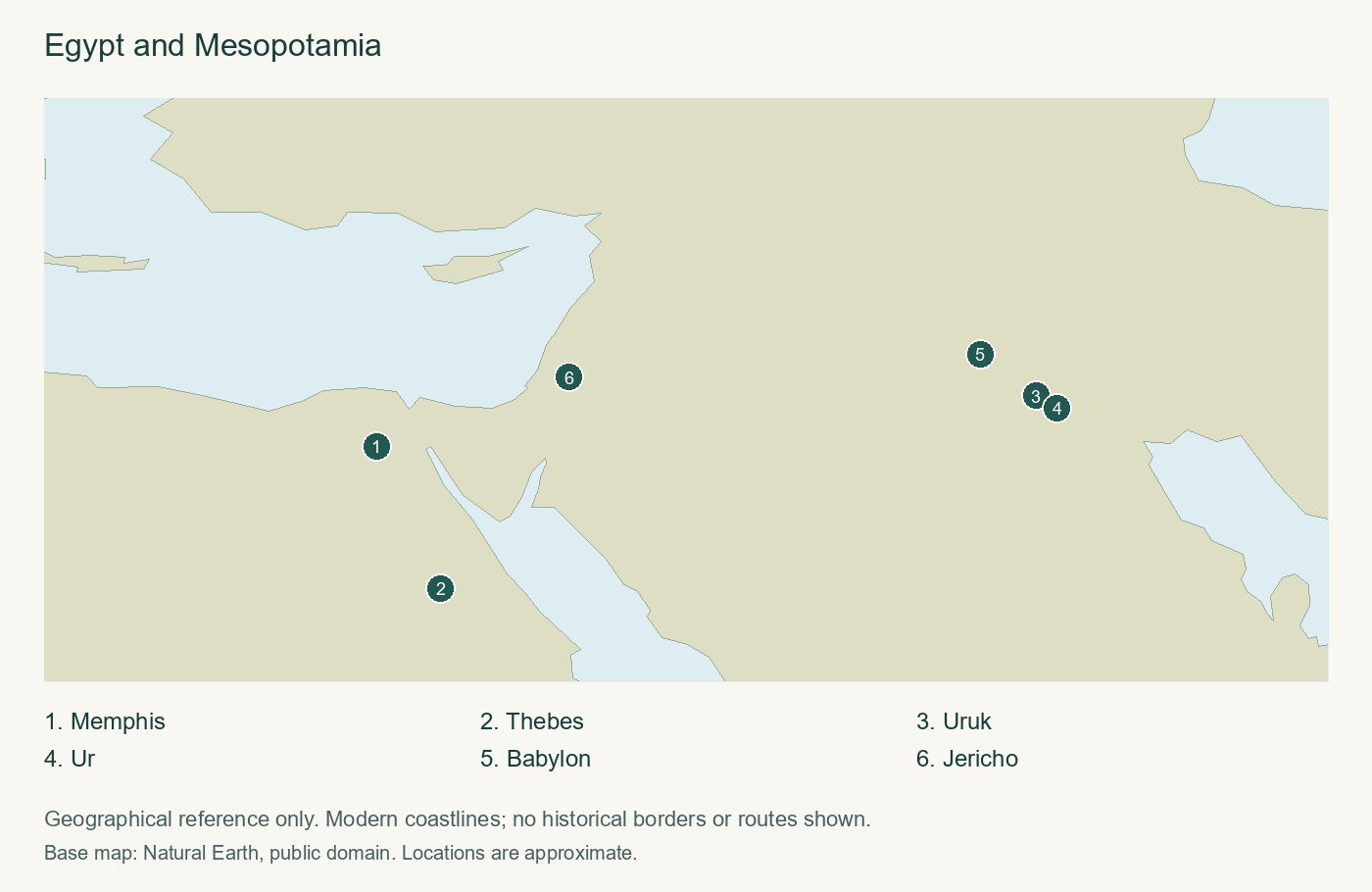
Jericho, or Tell es-Sultan, developed near an important spring. Its early wall, ditch and stone tower demonstrate considerable planning and labour. The tower survives to nearly eight metres, with an internal staircase. Kathleen Kenyon interpreted the structures as defensive, but other explanations include flood protection, communal identity and ritual. Their purpose cannot be settled simply by calling them fortifications.
Göbekli Tepe: monuments within community life
Göbekli Tepe in southeastern Anatolia contains monumental buildings dating mainly to about 9500-8000 BCE. Large T-shaped pillars, sometimes more than five metres high, were arranged within circular or oval structures. Carved animals and human-like features, including arms and hands, reveal a rich symbolic world. Quarrying and erecting the stones required coordinated labour.
An influential interpretation presented the site as a sanctuary used by dispersed hunter-gatherers. Evidence of domestic buildings and everyday food processing now supports a more complex relationship between monumental and ordinary life. Calling it an isolated temple overlooks this evidence.
Animal bones suggest substantial shared consumption. Large vessels and cereal-processing equipment have encouraged suggestions of fermented drinks, but beer production is not established. Modified human skulls demonstrate unusual treatment of the dead without proving one specific “death cult”. The monuments are secure evidence; identifying their builders’ precise beliefs is much harder.
Independent farming traditions and the later rise of cities
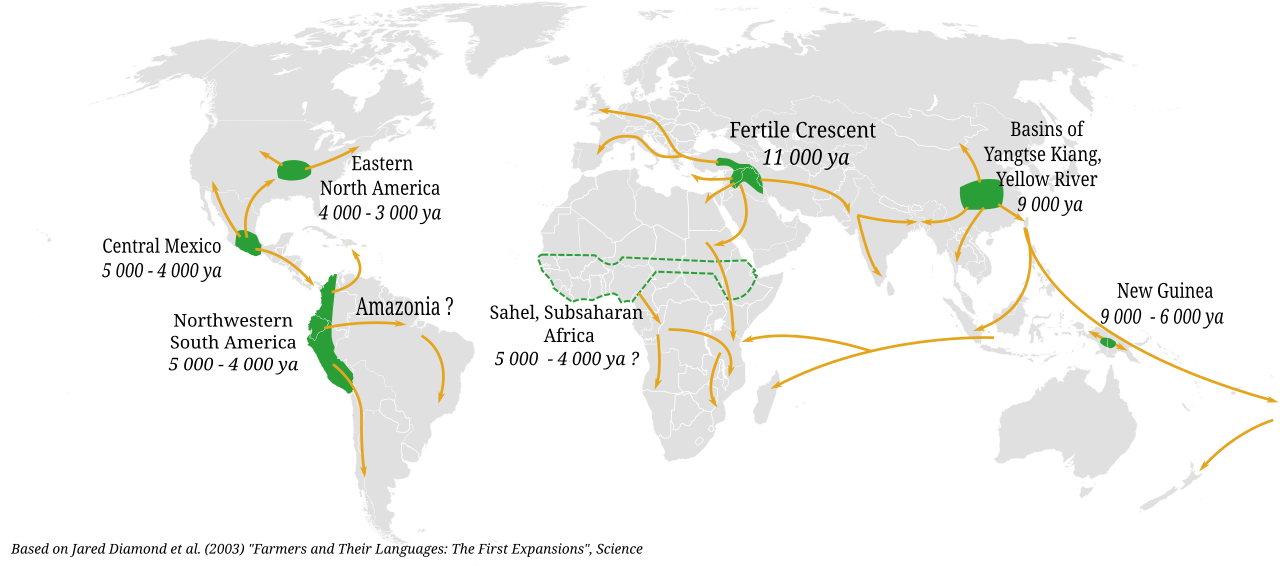
Food production developed in several regions. Southwest Asian communities cultivated wheat and barley and increasingly kept sheep, goats, cattle and pigs. Rice and millet were important in different parts of China; New Guinea developed distinctive plant-management traditions. Maize originated in Mesoamerica, while Andean societies domesticated crops and animals including potatoes, llamas and alpacas. Parts of Africa and eastern North America developed their own farming traditions. Local environments shaped the available combinations.
Over time, farming supported larger populations, but villages did not instantly become cities. During the fourth millennium BCE, southern Mesopotamian centres such as Uruk developed dense settlement, specialised labour and institutions managing production. Proto-cuneiform notation appeared around 3400-3200 BCE. Cities and writing thus emerged thousands of years after early settled communities. Their development depended on interacting changes in food production, population, exchange and authority rather than on a single climatic event or invention.
Revision questions
Write an answer before opening the explanation. Your answers stay in this browser.
01 Distinguish cultivation, domestication and settled life.
Read the explanation
Sedentism means remaining in one place for long periods or permanently. It did not invariably follow farming: rich wild resources could support extended settlement. Dogs were domesticated before agriculture, while specialised uses of other animals, such as intensive wool production, developed later. These different sequences explain why farming is better understood as a spectrum of practices than as a single invention.
02 How do Natufian communities challenge a simple sequence from farming to villages?
Read the explanation
At Shubayqa 1 in Jordan, bread-like remains about 14,400 years old were made using wild plants. Producing them required grinding, mixing and heating ingredients. Residues from Raqefet have been interpreted as evidence for a fermented cereal preparation. These discoveries show sophisticated food production, but do not prove that making beer caused farming.
Burials also reveal social and ritual life. An unusually elaborate grave at Hilazon Tachtit contained numerous animal remains and other objects. The proposal that the woman buried there was a ritual specialist is an interpretation of the evidence. At Abu Hureyra, outside the main Natufian area, intensive plant use and changing settlement patterns likewise illuminate adaptation; claims about very early rye cultivation remain debated. The chronology of the Zarzian traditions in the Zagros is also less certain than a simple sequence suggests.
03 What does Göbekli Tepe reveal, and why must interpretations remain cautious?
Read the explanation
An influential interpretation presented the site as a sanctuary used by dispersed hunter-gatherers. Evidence of domestic buildings and everyday food processing now supports a more complex relationship between monumental and ordinary life. Calling it an isolated temple overlooks this evidence.
Animal bones suggest substantial shared consumption. Large vessels and cereal-processing equipment have encouraged suggestions of fermented drinks, but beer production is not established. Modified human skulls demonstrate unusual treatment of the dead without proving one specific “death cult”. The monuments are secure evidence; identifying their builders’ precise beliefs is much harder.
04 Why should the development of farming and cities not be treated as one universal event?
Read the explanation
Over time, farming supported larger populations, but villages did not instantly become cities. During the fourth millennium BCE, southern Mesopotamian centres such as Uruk developed dense settlement, specialised labour and institutions managing production. Proto-cuneiform notation appeared around 3400-3200 BCE. Cities and writing thus emerged thousands of years after early settled communities. Their development depended on interacting changes in food production, population, exchange and authority rather than on a single climatic event or invention.