The League of Nations was established after the First World War to promote peace through international cooperation. It began formally on 10 January 1920, when the Treaty of Versailles entered into force, and developed its headquarters in Geneva. The League settled some disputes and carried out significant humanitarian work, yet failed to stop major acts of aggression in the 1930s. Its history reveals both the possibilities of cooperation and the limits of an organisation dependent on its member governments.
The Covenant and the idea of collective security
The League's founding document, the Covenant, formed the first part of the Treaty of Versailles. Its supporters wanted disputes to be addressed through discussion, arbitration and international law rather than war. Disarmament was intended to reduce the danger of an arms race, while cooperation in health, labour and economic affairs would address problems that crossed borders.
Collective security meant that aggression against one state should concern the wider international community. Article 10 committed members to respect and preserve other members' territorial integrity and political independence against external aggression. Article 16 provided for sanctions against a state resorting to war in breach of the Covenant. In principle, an aggressor would face the combined pressure of many countries rather than only its immediate victim.
The League did not replace national governments or possess a permanent army. Military enforcement would require states to supply forces and accept the risk of war. Economic sanctions likewise depended on governments actually restricting trade and finance. An ambitious promise therefore rested on voluntary cooperation among states with different interests.
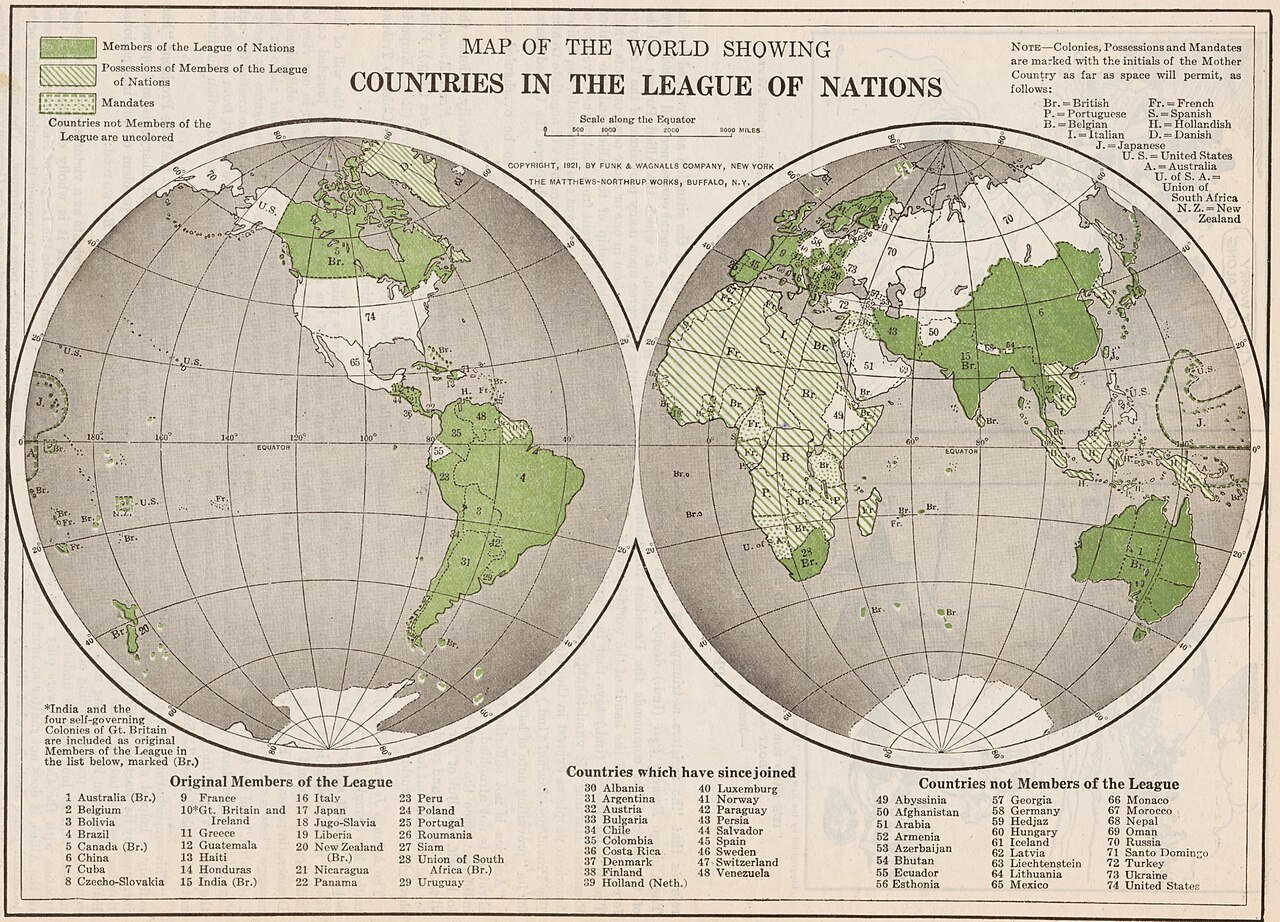
Membership and the missing great powers
President Woodrow Wilson strongly supported the League, but the United States never joined. The US Senate did not give the required consent to ratify the Treaty of Versailles. Opponents disagreed among themselves: some rejected the League, while others sought reservations protecting American freedom of action. Article 10 was particularly controversial because it appeared to create obligations in future overseas conflicts.
American absence deprived the League of an exceptionally powerful economy and potential source of military support. It also complicated sanctions, since trade might continue through countries outside the organisation. This did not make every League initiative impossible, but it weakened the credibility of a universal security system.
Germany, initially excluded, entered in 1926 after the improvement in relations associated with Locarno. Hitler announced withdrawal in 1933. The Soviet Union joined in 1934 as concern about Nazi Germany increased, but was expelled in 1939 after its attack on Finland. Japan announced withdrawal in 1933, and Italy did so in 1937. The League was therefore never a stable association of all the major powers.
How the League worked
The Assembly represented all members, each with one vote, and normally met annually. It discussed broad policy, budgets and membership. The smaller Council handled urgent political questions. At the outset, its active permanent members were the British Empire, France, Italy and Japan, alongside elected non-permanent members. Germany later gained a permanent seat.
Many important decisions required unanimity, although procedures included exceptions and rules concerning parties to disputes. Seeking broad agreement could give decisions legitimacy, but could also delay action or permit obstruction. The fundamental problem was not simply a complicated meeting system: members retained the power to decide how far they would support enforcement.
The Secretariat prepared meetings, collected information and coordinated ongoing work. The Permanent Court of International Justice at The Hague issued judgments in cases within its accepted jurisdiction and advisory opinions. It had no independent police force. The International Labour Organization, established alongside the League system, brought governments, employers and workers into discussions about labour standards.
Responses to disputes could begin with investigation, mediation and public condemnation. Arbitration meant accepting a third party or agreed procedure to settle a disagreement. Economic sanctions could restrict trade or financial transactions. The stronger the proposed response, however, the greater the cost and risk that governments had to accept.
Successful settlements in the 1920s
The Åland Islands were disputed by Sweden and Finland. In 1921, the League recognised Finnish sovereignty while protecting the islands' Swedish language and culture and maintaining demilitarisation. The settlement worked because the parties could accept a compromise supported by international guarantees.
Upper Silesia was more difficult. A plebiscite required by Versailles took place under Inter-Allied supervision in 1921, but mixed populations, valuable industry and conflict prevented an easy settlement. The League recommended partition between Germany and Poland, accompanied by arrangements protecting economic links and minorities. The outcome was accepted even though it did not satisfy every local claim.
In 1925, Greek troops entered Bulgaria after a frontier incident. Bulgaria appealed to the League, which demanded an end to fighting and Greek withdrawal. Compliance showed that international pressure could contain a conflict. These cases were genuine achievements, but they did not establish that the same methods would work against a major power determined to expand.
Refugees, health and labour
Fridtjof Nansen played an important role in work for refugees and former prisoners of war. International cooperation helped hundreds of thousands of prisoners return home after the war. The Nansen passport, introduced through arrangements beginning in 1922, gave refugees and stateless people recognised travel documentation when ordinary national passports were unavailable.
The League's health work encouraged information-sharing and action against diseases such as typhus, cholera and malaria. It helped develop habits and institutions of international public-health cooperation. This organisation was not the later World Health Organization, although its experience contributed to the history of that field.
The ILO promoted conventions on issues including working hours and exposure to dangerous substances such as white lead. Adoption of a convention did not mean identical enforcement everywhere: national ratification and implementation mattered. The 1926 Slavery Convention and related investigations similarly advanced international standards without eliminating slavery and coercive labour at once. These achievements are essential to judging the League as more than a failed military alliance.
Early limits: Vilna, the Ruhr and Corfu
Polish forces seized Vilna, claimed by Lithuania, in 1920. International efforts did not reverse Polish control, exposing the difficulty of enforcing a settlement against a state holding the territory when stronger powers would not intervene. The French and Belgian occupation of the Ruhr in 1923 also showed that major governments could pursue their interests largely outside normal League machinery.
Corfu provided a particularly damaging example. After an Italian boundary commission led by General Enrico Tellini was killed near the Greek-Albanian frontier in August 1923, Mussolini blamed Greece and demanded compensation. Italian forces bombarded and occupied Corfu. Greece appealed to the League, but the Conference of Ambassadors took over the dispute and Greece ultimately met important Italian demands before Italy withdrew.
The outcome suggested that a permanent Council member could use force and avoid the restraint imposed on weaker states. Corfu therefore mattered even though the occupation ended. Compared with the successful pressure on Greece in 1925, it revealed the unequal application of collective-security principles.
Depression and the failure of disarmament
The economic crisis beginning in 1929 damaged production, employment and international trade. Governments introduced protective measures and concentrated on domestic survival. Aggressive movements could present territorial expansion as a solution to shortages, insecurity or national humiliation. At the same time, other governments became less willing to risk trade losses or military expenditure to enforce League decisions.
These pressures intensified existing weaknesses rather than creating them from nothing. Britain and France remained concerned with their own security and empires. States disagreed over what counted as fair disarmament and whether security guarantees had to come first. Germany demanded equality, while France feared the consequences of permitting German rearmament without reliable protection.
The World Disarmament Conference opened in 1932 but failed to reach a durable general settlement. Germany left the conference in 1933, alongside its decision to leave the League. The gap widened between the promise of peaceful revision and the reality of growing military competition.
Manchuria: conquest before an effective response
Japan already possessed important economic and strategic interests in north-eastern China, especially around the South Manchurian Railway. Manchuria offered resources, land and opportunities for influence. The Depression damaged Japanese exports, while officers of the Kwantung Army favoured expansion and acted with considerable independence from civilian authorities.
Following the Mukden railway incident on 18 September 1931, Japanese forces rapidly expanded their occupation. China appealed to the League. Japan supported the creation of Manchukuo in 1932, placing the former Chinese emperor Puyi at the head of a state under heavy Japanese control. Formal independence concealed the reality of domination.
The League appointed a commission led by the Earl of Lytton. Its investigation took place while Japan consolidated its gains, and the report was published in 1932. It rejected the claim that Manchukuo represented genuine local self-determination. In February 1933, the Assembly accepted the substance of the findings, but Japan rejected the judgement and announced withdrawal from the League.
Investigation and non-recognition did not remove Japanese troops. Britain and France feared an expensive conflict far from Europe, while American non-membership complicated comprehensive sanctions. Japan was a powerful state able to threaten wider interests. The failure was therefore a combination of delay, distance, incomplete membership and unwillingness to use sufficient pressure, not simply the time taken by investigators to travel.
Abyssinia: limited sanctions and conflicting priorities
Abyssinia, now Ethiopia, was an independent African state and a League member. Italy controlled neighbouring Eritrea and Italian Somaliland. Mussolini wanted imperial prestige, territorial expansion and revenge for Italy's defeat at Adwa in 1896. A clash at Walwal in December 1934 became a pretext for further pressure while Italy prepared for war.
Britain and France also wanted Italian cooperation against German treaty violations. The Stresa Front of April 1935 expressed that concern, creating tension between European strategy and the obligation to protect Abyssinia. Italy invaded on 3 October 1935, using superior equipment, aerial bombardment and chemical weapons, including mustard gas.
The League identified Italy as the aggressor and introduced sanctions. However, oil was excluded, and the Suez Canal remained open to Italian shipping. Britain possessed strong strategic influence over the route but feared that closing it might lead to war. The measures therefore demonstrated some collective action while leaving major means of pressure unused.
In December 1935, the secret Hoare-Laval proposals offered Italy extensive gains in return for ending the conflict. Their exposure caused public outrage and the resignation of British Foreign Secretary Samuel Hoare. The plan damaged the League because leading governments appeared willing to reward the aggression they publicly condemned.
Italian forces occupied Addis Ababa in May 1936. Emperor Haile Selassie's appeal to the League in June highlighted the failure to protect a member, but did not reverse the conquest. Sanctions were removed in July. Abyssinia was especially damaging because the great powers possessed more direct leverage than in Manchuria and deliberately limited its use.
Explaining the League's failure without ignoring its achievements
The League worked most effectively where states accepted compromise or where technical cooperation served common interests. Its humanitarian work and several dispute settlements were real achievements. It failed most visibly when determined great powers pursued expansion and other governments would not bear the costs of resistance.
No single explanation is sufficient. Incomplete membership weakened sanctions; unanimity and the absence of an independent army constrained action; the Depression increased both aggression and caution. Yet institutions did not act on their own. Decisions by Britain, France and other governments turned structural weaknesses into concrete failures.
Manchuria showed that condemnation could not reverse conquest. Abyssinia showed that even available economic and strategic pressure might be withheld. Together these crises undermined confidence in collective security. The League was formally dissolved in 1946, after the United Nations had begun work, but its experience remained influential in later attempts to organise international cooperation.
Revision questions
Write an answer before opening the explanation. Your answers stay in this browser.
01 What was collective security, and why did it depend on member governments?
Read the explanation
Collective security meant that aggression against one state should concern the wider international community. Article 10 committed members to respect and preserve other members' territorial integrity and political independence against external aggression. Article 16 provided for sanctions against a state resorting to war in breach of the Covenant. In principle, an aggressor would face the combined pressure of many countries rather than only its immediate victim.
The League did not replace national governments or possess a permanent army. Military enforcement would require states to supply forces and accept the risk of war. Economic sanctions likewise depended on governments actually restricting trade and finance. An ambitious promise therefore rested on voluntary cooperation among states with different interests.
02 How did incomplete membership weaken the League?
Read the explanation
American absence deprived the League of an exceptionally powerful economy and potential source of military support. It also complicated sanctions, since trade might continue through countries outside the organisation. This did not make every League initiative impossible, but it weakened the credibility of a universal security system.
Germany, initially excluded, entered in 1926 after the improvement in relations associated with Locarno. Hitler announced withdrawal in 1933. The Soviet Union joined in 1934 as concern about Nazi Germany increased, but was expelled in 1939 after its attack on Finland. Japan announced withdrawal in 1933, and Italy did so in 1937. The League was therefore never a stable association of all the major powers.
03 Explain one successful settlement from the 1920s and the conditions that made it possible.
Read the explanation
Upper Silesia was more difficult. A plebiscite required by Versailles took place under Inter-Allied supervision in 1921, but mixed populations, valuable industry and conflict prevented an easy settlement. The League recommended partition between Germany and Poland, accompanied by arrangements protecting economic links and minorities. The outcome was accepted even though it did not satisfy every local claim.
In 1925, Greek troops entered Bulgaria after a frontier incident. Bulgaria appealed to the League, which demanded an end to fighting and Greek withdrawal. Compliance showed that international pressure could contain a conflict. These cases were genuine achievements, but they did not establish that the same methods would work against a major power determined to expand.
04 Why must humanitarian and technical achievements be included in a judgement of the League?
Read the explanation
The League's health work encouraged information-sharing and action against diseases such as typhus, cholera and malaria. It helped develop habits and institutions of international public-health cooperation. This organisation was not the later World Health Organization, although its experience contributed to the history of that field.
The ILO promoted conventions on issues including working hours and exposure to dangerous substances such as white lead. Adoption of a convention did not mean identical enforcement everywhere: national ratification and implementation mattered. The 1926 Slavery Convention and related investigations similarly advanced international standards without eliminating slavery and coercive labour at once. These achievements are essential to judging the League as more than a failed military alliance.
05 Why did investigation and condemnation fail to reverse Japan's conquest of Manchuria?
Read the explanation
Following the Mukden railway incident on 18 September 1931, Japanese forces rapidly expanded their occupation. China appealed to the League. Japan supported the creation of Manchukuo in 1932, placing the former Chinese emperor Puyi at the head of a state under heavy Japanese control. Formal independence concealed the reality of domination.
The League appointed a commission led by the Earl of Lytton. Its investigation took place while Japan consolidated its gains, and the report was published in 1932. It rejected the claim that Manchukuo represented genuine local self-determination. In February 1933, the Assembly accepted the substance of the findings, but Japan rejected the judgement and announced withdrawal from the League.
Investigation and non-recognition did not remove Japanese troops. Britain and France feared an expensive conflict far from Europe, while American non-membership complicated comprehensive sanctions. Japan was a powerful state able to threaten wider interests. The failure was therefore a combination of delay, distance, incomplete membership and unwillingness to use sufficient pressure, not simply the time taken by investigators to travel.
06 Why were sanctions and diplomacy ineffective in protecting Abyssinia?
Read the explanation
In December 1935, the secret Hoare-Laval proposals offered Italy extensive gains in return for ending the conflict. Their exposure caused public outrage and the resignation of British Foreign Secretary Samuel Hoare. The plan damaged the League because leading governments appeared willing to reward the aggression they publicly condemned.
Italian forces occupied Addis Ababa in May 1936. Emperor Haile Selassie's appeal to the League in June highlighted the failure to protect a member, but did not reverse the conquest. Sanctions were removed in July. Abyssinia was especially damaging because the great powers possessed more direct leverage than in Manchuria and deliberately limited its use.
07 How did institutional weaknesses and national interests combine to undermine collective security?
Read the explanation
No single explanation is sufficient. Incomplete membership weakened sanctions; unanimity and the absence of an independent army constrained action; the Depression increased both aggression and caution. Yet institutions did not act on their own. Decisions by Britain, France and other governments turned structural weaknesses into concrete failures.
Manchuria showed that condemnation could not reverse conquest. Abyssinia showed that even available economic and strategic pressure might be withheld. Together these crises undermined confidence in collective security. The League was formally dissolved in 1946, after the United Nations had begun work, but its experience remained influential in later attempts to organise international cooperation.