The outbreak of war in Europe in September 1939 resulted from a series of connected crises and political decisions. Resentment over the peace treaties, economic depression and the weakness of collective security created opportunities for expansionist states. Hitler's policies transformed those opportunities into repeated acts of aggression. Appeasement and the Nazi-Soviet Pact affected the circumstances in which he acted, but neither removes the responsibility of the governments that chose conquest and war.
The weakening of the international order
The peace treaties of 1919-1923 left disputed borders and dissatisfied states. German nationalists attacked Versailles as unjust, while some people in Britain also considered parts of the settlement too severe. Yet dissatisfaction did not make another war inevitable. Agreements such as Locarno in 1925 and Germany's entry into the League in 1926 demonstrated that diplomatic improvement was possible.
The Great Depression changed the political environment. Unemployment and declining trade undermined confidence in governments, strengthened extremist movements and encouraged economic nationalism. Expansion could be presented as a way to obtain resources and prestige. Meanwhile, countries facing their own economic problems hesitated to pay the costs of resisting aggression elsewhere.
Japan's conquest of Manchuria and Italy's invasion of Abyssinia exposed the limits of the League of Nations. The failure of the disarmament conference further weakened hopes of agreed military restraint. These events did not give Hitler a formal permission to expand, but they suggested that determined action might meet condemnation without effective resistance.
The aims of Germany, Italy and Japan
Hitler wanted to overturn Versailles, rebuild German military power and bring German-speaking populations under his rule. His ambitions extended beyond the revision of particular treaty clauses. The Nazi demand for Lebensraum, or living space, envisaged conquest in eastern Europe and was bound to racist ideas, anti-communism and the subjugation of other peoples.
Mussolini sought an enlarged Italian empire and recognition as a great power. Italy's ambitions in the Mediterranean and Africa sometimes conflicted with German interests, especially over Austria. Cooperation between the dictators developed over time rather than existing automatically from the beginning.
Japanese military leaders sought greater control in East Asia, with resources, strategic security and imperial prestige among their objectives. Full-scale war with China expanded in 1937. Germany, Italy and Japan shared hostility to aspects of the existing order, but did not operate throughout the 1930s according to one unified plan. The Rome-Berlin Axis in 1936 and the Anti-Comintern Pact linked them more closely; the Pact of Steel between Germany and Italy followed in 1939.
Rearmament and the first treaty challenges
After becoming chancellor in 1933, Hitler accelerated rearmament and withdrew Germany from the disarmament conference and the League. In 1935 he openly announced conscription and the existence of the Luftwaffe. These steps violated Versailles and enlarged Germany's capacity to threaten its neighbours.
Britain, France and Italy condemned German treaty violations at Stresa in April 1935. However, Britain's separate Anglo-German Naval Agreement in June allowed a German surface fleet up to thirty-five per cent of British tonnage, with separate submarine provisions. Britain hoped to place limits on naval competition, but the agreement weakened a united response to treaty-breaking.
The Saar returned to Germany after the internationally supervised plebiscite of January 1935. This was a change permitted by Versailles and should be distinguished from violations of the treaty. Hitler used the result as evidence of national support for his leadership.
On 7 March 1936, German troops entered the demilitarised Rhineland, violating Versailles and Locarno. France did not intervene militarily, and Britain was unwilling to support force. Germany's successful gamble strengthened Hitler's prestige and made future resistance to German expansion more difficult by improving its western strategic position.
Spain and the changing alignment of powers
The Spanish Civil War began in 1936 after a military rising against the Republic. Germany and Italy supported the Nationalists led by Francisco Franco, while the Soviet Union supplied the Republic and foreign volunteers joined the International Brigades. Britain and France pursued non-intervention, although outside assistance continued despite the policy.
German and Italian involvement strengthened their relationship and provided experience in modern warfare. The bombing of Guernica in 1937 became a powerful symbol of the danger aerial warfare posed to civilians. The conflict also heightened ideological division across Europe, making cooperation against other threats more difficult.
Italy had opposed German interference in Austria after the murder of Chancellor Engelbert Dollfuss in 1934. By the later 1930s, its closer relationship with Germany changed that position. This shift removed an important obstacle to Hitler's ambitions in Austria.
Anschluss and the destruction of Czechoslovakia
In early 1938, Hitler increased pressure on Austrian Chancellor Kurt Schuschnigg. When Schuschnigg proposed a vote on Austrian independence, Hitler demanded concessions and German troops entered Austria on 12 March. Annexation, known as Anschluss, followed. A later vote held under Nazi control cannot be treated as a free test of opinion, even though the union had substantial popular support among some groups.
Hitler then targeted Czechoslovakia's Sudeten borderlands, home to a large German-speaking population. Konrad Henlein's Sudeten German Party advanced demands that helped destabilise the state. The dispute concerned national claims, but also valuable industry, defensive fortifications and the survival of Czechoslovakia as an independent country.
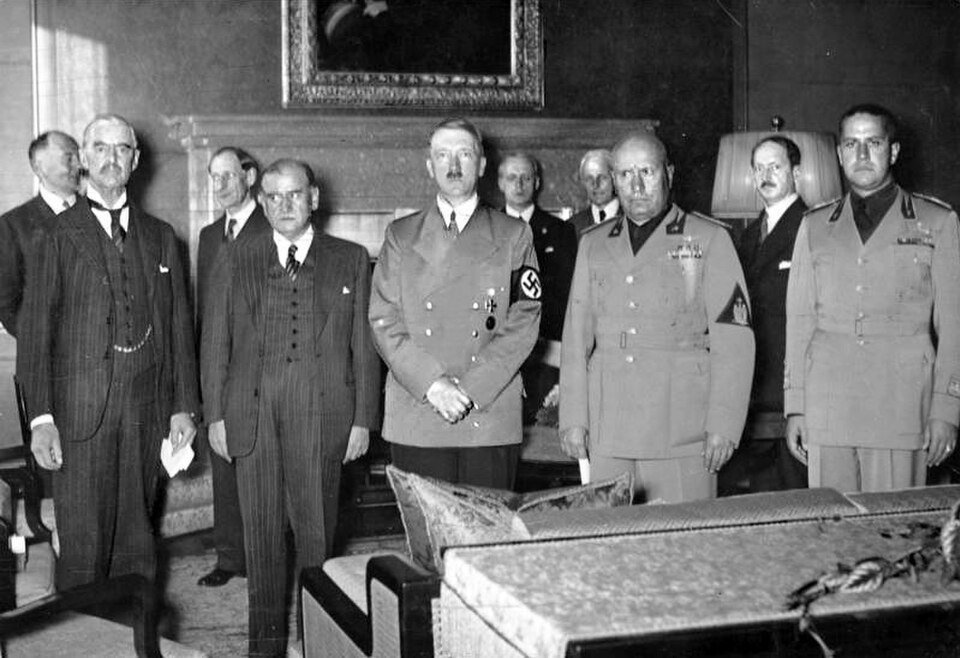
British Prime Minister Neville Chamberlain negotiated with Hitler during September 1938. At Munich on 29-30 September, Britain, France, Germany and Italy agreed to the transfer of the Sudeten territories. Czechoslovakia was excluded from the negotiations determining its fate, and the Soviet Union was not a participant. Losing the frontier defences and resources made the remaining state much more vulnerable.
In March 1939, German forces occupied Prague and Hitler established the Protectorate of Bohemia and Moravia. Slovakia became a formally independent state under strong German influence. The takeover demonstrated that his ambitions went beyond uniting German-speaking populations, undermining the argument that limited concessions would satisfy him.
Why Britain and France pursued appeasement
Appeasement sought to avoid war by negotiating concessions believed capable of resolving grievances. Memories of the First World War and fears of bombing made another conflict deeply unpopular. Economic pressures and uncertainty about military readiness encouraged caution. British planners also had to consider global imperial commitments and possible threats from Japan and Italy.
Some policymakers thought particular German demands had merit, especially revisions involving national identity. Others feared communism and distrusted the Soviet Union. Chamberlain hoped direct negotiations could produce a durable settlement. These motives overlapped; appeasement was not simply cowardice or the belief that every statement Hitler made was true.
The policy did give Britain additional time to rearm, including the expansion of air defences. However, Germany also gained time, territory, resources and strategic advantages. Czechoslovakia lost the ability to resist effectively, and Soviet distrust of the western powers increased. A fair assessment must weigh the constraints facing policymakers against the consequences for the states whose interests were sacrificed.
It cannot be proved that one different decision would certainly have prevented all later war. Nonetheless, repeated concessions weakened deterrence and encouraged Hitler to believe that further risks might succeed. After the occupation of Prague, Britain offered a guarantee of Polish independence, while rearmament and preparations for war intensified.
The Nazi-Soviet Pact
Negotiations between Britain, France and the Soviet Union in 1939 failed to produce an effective alliance. Mutual distrust, doubts about military commitments and Polish opposition to the passage of Soviet troops obstructed agreement. Stalin's purges had also damaged the Red Army and affected foreign assessments of Soviet strength. These difficulties created an opening for a German-Soviet arrangement, without making Stalin's choice unavoidable.
On 23 August 1939, foreign ministers Joachim von Ribbentrop and Vyacheslav Molotov signed a non-aggression pact. Its public terms promised that Germany and the USSR would not attack each other. A secret protocol divided areas of eastern Europe into spheres of influence, including arrangements concerning Poland and the Baltic region.
Hitler reduced the immediate danger of Soviet opposition to an attack on Poland. Stalin gained an opportunity for territorial expansion and time before a possible German war against the USSR. Their ideological hostility did not disappear: the agreement was a tactical arrangement between dictators with incompatible long-term aims. It encouraged aggression by isolating Poland, but the invasion still depended on decisions taken by German leaders.
Poland and the outbreak of European war
Germany invaded Poland on 1 September 1939. Britain and France demanded withdrawal and declared war on Germany on 3 September when it did not comply. Their response reflected both their commitments to Poland and the conclusion that further concessions would not produce a reliable peace. The Soviet Union invaded eastern Poland on 17 September, implementing its own expansion under the pact.
The invasion of Poland was the immediate trigger for war between Germany and the western powers. Behind it lay Hitler's ambitions, the military strength created through rearmament, the erosion of collective security and the diplomatic choices of several governments. Distinguishing these levels of causation avoids treating the treaty of 1919 or the agreement of August 1939 as a complete explanation by itself.
From European conflict to world war
German forces attacked Denmark and Norway in April 1940, then the Low Countries and France in May. France's defeat in June transformed the European balance. Britain continued fighting, and the Royal Air Force resisted German efforts to gain air superiority during the Battle of Britain. Bombing campaigns nevertheless inflicted severe civilian suffering.
Germany invaded the Soviet Union in June 1941, breaking the Nazi-Soviet Pact. Japan's attack on Pearl Harbor in December, followed by Germany's declaration of war on the United States, widened the conflict further. In occupied Europe, Nazi persecution developed into systematic mass murder. The Holocaust killed approximately six million Jews; the regime also persecuted and murdered other groups. The Wannsee Conference of January 1942 coordinated aspects of a genocide already under way, rather than beginning persecution from nothing.
Allied victories at Midway, El Alamein and Stalingrad during 1942-1943 helped shift the military balance. Continued Soviet advances and the Normandy landings of June 1944 placed Germany under growing pressure from east and west. Germany surrendered in May 1945. In August, American atomic bombs devastated Hiroshima and Nagasaki, while the Soviet Union entered the war against Japan; Japan's formal surrender followed on 2 September.
The war's scale of death, displacement and destruction demonstrates what was at stake in the collapse of peace. Explaining that collapse does not require assuming the outcome was inevitable. It requires tracing how aggressive aims, opportunities and responses accumulated until the decision to invade Poland produced a wider war.
Revision questions
Write an answer before opening the explanation. Your answers stay in this browser.
01 How did the international context create opportunities for expansionist states?
Read the explanation
The Great Depression changed the political environment. Unemployment and declining trade undermined confidence in governments, strengthened extremist movements and encouraged economic nationalism. Expansion could be presented as a way to obtain resources and prestige. Meanwhile, countries facing their own economic problems hesitated to pay the costs of resisting aggression elsewhere.
Japan's conquest of Manchuria and Italy's invasion of Abyssinia exposed the limits of the League of Nations. The failure of the disarmament conference further weakened hopes of agreed military restraint. These events did not give Hitler a formal permission to expand, but they suggested that determined action might meet condemnation without effective resistance.
02 Distinguish the Saar plebiscite from rearmament and the remilitarisation of the Rhineland.
Read the explanation
Britain, France and Italy condemned German treaty violations at Stresa in April 1935. However, Britain's separate Anglo-German Naval Agreement in June allowed a German surface fleet up to thirty-five per cent of British tonnage, with separate submarine provisions. Britain hoped to place limits on naval competition, but the agreement weakened a united response to treaty-breaking.
The Saar returned to Germany after the internationally supervised plebiscite of January 1935. This was a change permitted by Versailles and should be distinguished from violations of the treaty. Hitler used the result as evidence of national support for his leadership.
On 7 March 1936, German troops entered the demilitarised Rhineland, violating Versailles and Locarno. France did not intervene militarily, and Britain was unwilling to support force. Germany's successful gamble strengthened Hitler's prestige and made future resistance to German expansion more difficult by improving its western strategic position.
03 How did the Spanish Civil War affect relations between European powers?
Read the explanation
German and Italian involvement strengthened their relationship and provided experience in modern warfare. The bombing of Guernica in 1937 became a powerful symbol of the danger aerial warfare posed to civilians. The conflict also heightened ideological division across Europe, making cooperation against other threats more difficult.
Italy had opposed German interference in Austria after the murder of Chancellor Engelbert Dollfuss in 1934. By the later 1930s, its closer relationship with Germany changed that position. This shift removed an important obstacle to Hitler's ambitions in Austria.
04 How did events from Anschluss to Prague undermine the hope of limited German revision?
Read the explanation
Hitler then targeted Czechoslovakia's Sudeten borderlands, home to a large German-speaking population. Konrad Henlein's Sudeten German Party advanced demands that helped destabilise the state. The dispute concerned national claims, but also valuable industry, defensive fortifications and the survival of Czechoslovakia as an independent country.
British Prime Minister Neville Chamberlain negotiated with Hitler during September 1938. At Munich on 29-30 September, Britain, France, Germany and Italy agreed to the transfer of the Sudeten territories. Czechoslovakia was excluded from the negotiations determining its fate, and the Soviet Union was not a participant. Losing the frontier defences and resources made the remaining state much more vulnerable.
In March 1939, German forces occupied Prague and Hitler established the Protectorate of Bohemia and Moravia. Slovakia became a formally independent state under strong German influence. The takeover demonstrated that his ambitions went beyond uniting German-speaking populations, undermining the argument that limited concessions would satisfy him.
05 Assess both the reasons for appeasement and its consequences.
Read the explanation
Some policymakers thought particular German demands had merit, especially revisions involving national identity. Others feared communism and distrusted the Soviet Union. Chamberlain hoped direct negotiations could produce a durable settlement. These motives overlapped; appeasement was not simply cowardice or the belief that every statement Hitler made was true.
The policy did give Britain additional time to rearm, including the expansion of air defences. However, Germany also gained time, territory, resources and strategic advantages. Czechoslovakia lost the ability to resist effectively, and Soviet distrust of the western powers increased. A fair assessment must weigh the constraints facing policymakers against the consequences for the states whose interests were sacrificed.
It cannot be proved that one different decision would certainly have prevented all later war. Nonetheless, repeated concessions weakened deterrence and encouraged Hitler to believe that further risks might succeed. After the occupation of Prague, Britain offered a guarantee of Polish independence, while rearmament and preparations for war intensified.
06 Why did Hitler and Stalin sign a pact despite their ideological hostility?
Read the explanation
On 23 August 1939, foreign ministers Joachim von Ribbentrop and Vyacheslav Molotov signed a non-aggression pact. Its public terms promised that Germany and the USSR would not attack each other. A secret protocol divided areas of eastern Europe into spheres of influence, including arrangements concerning Poland and the Baltic region.
Hitler reduced the immediate danger of Soviet opposition to an attack on Poland. Stalin gained an opportunity for territorial expansion and time before a possible German war against the USSR. Their ideological hostility did not disappear: the agreement was a tactical arrangement between dictators with incompatible long-term aims. It encouraged aggression by isolating Poland, but the invasion still depended on decisions taken by German leaders.
07 Distinguish the immediate trigger of European war from its wider causes.
Read the explanation
The invasion of Poland was the immediate trigger for war between Germany and the western powers. Behind it lay Hitler's ambitions, the military strength created through rearmament, the erosion of collective security and the diplomatic choices of several governments. Distinguishing these levels of causation avoids treating the treaty of 1919 or the agreement of August 1939 as a complete explanation by itself.