The Cold War was a prolonged rivalry between the United States and the Soviet Union and their respective allies. It involved competing political systems, strategic interests and visions of international order. The superpowers avoided a declared, full-scale war against each other, but the rivalry contributed to destructive wars elsewhere, nuclear confrontation and political repression. Its course was shaped not only by Washington and Moscow, but also by governments and movements pursuing their own aims around the world.
From wartime alliance to post-war distrust
The United States and the USSR cooperated against Nazi Germany despite deep ideological differences. The American political system combined competitive elections with a predominantly capitalist economy; the Soviet system concentrated power in the Communist Party and relied heavily on state ownership and planning. Neither description means that every American ally was democratic or that all communist states followed Moscow without disagreement.
At Yalta in February 1945, Roosevelt, Churchill and Stalin discussed Germany's defeat, occupation and the future of Europe. Agreements about representative government and elections concealed different understandings of what would follow. By the Potsdam Conference in July and August, Roosevelt had died and Truman had become president; Attlee replaced Churchill during the conference after Britain's election.
The USSR had suffered devastating destruction and approximately twenty-seven million deaths. Stalin sought reparations and a protective zone of friendly governments. The United States emerged with exceptional economic power and, initially, a monopoly on atomic weapons. Soviet security demands and American support for political and economic openness increasingly appeared threatening to one another.
Eastern Europe and the policy of containment
Between 1945 and 1948, communist parties consolidated power across much of eastern Europe with Soviet backing. The methods varied, but included pressure on opponents, manipulated elections and control of security institutions. The communist takeover in Czechoslovakia in February 1948 intensified western fears. Soviet leaders described friendly regimes as protection; critics saw the destruction of political independence.
Churchill's Iron Curtain speech in 1946 gave a memorable name to Europe's division. In March 1947, the Truman Doctrine promised support for peoples resisting subjugation, with immediate aid directed toward Greece and Turkey. It became associated with containment, the policy of preventing further communist expansion rather than necessarily overthrowing existing communist governments.
The Marshall Plan, announced in June 1947 and implemented from 1948, provided large-scale assistance for European recovery. American policymakers linked prosperity with political stability and trade. Stalin saw a threat of American influence and prevented Soviet-bloc participation. Cominform, established in 1947, coordinated communist parties, while Comecon, founded in 1949, provided a framework for economic cooperation in the Soviet bloc.
Germany and the Berlin Blockade
Germany was divided into American, British, French and Soviet occupation zones. Berlin, although inside the Soviet zone, was also divided into four sectors. What was intended as an occupation arrangement became entangled in disagreements over reparations, reconstruction and the political future of Germany.
The western powers moved toward economic integration of their zones and introduced a new currency in 1948. Stalin feared a strengthened western German state aligned with the United States. In June, Soviet authorities cut the principal land and water routes supplying the western sectors of Berlin. Air corridors remained available: the city was not sealed against every possible form of transport.
The western response was an airlift carrying food, fuel and other supplies. It sustained the population without a military attempt to force open the ground routes. The blockade ended in May 1949, having failed to remove the western powers from Berlin. The crisis deepened distrust and accelerated Europe's division.
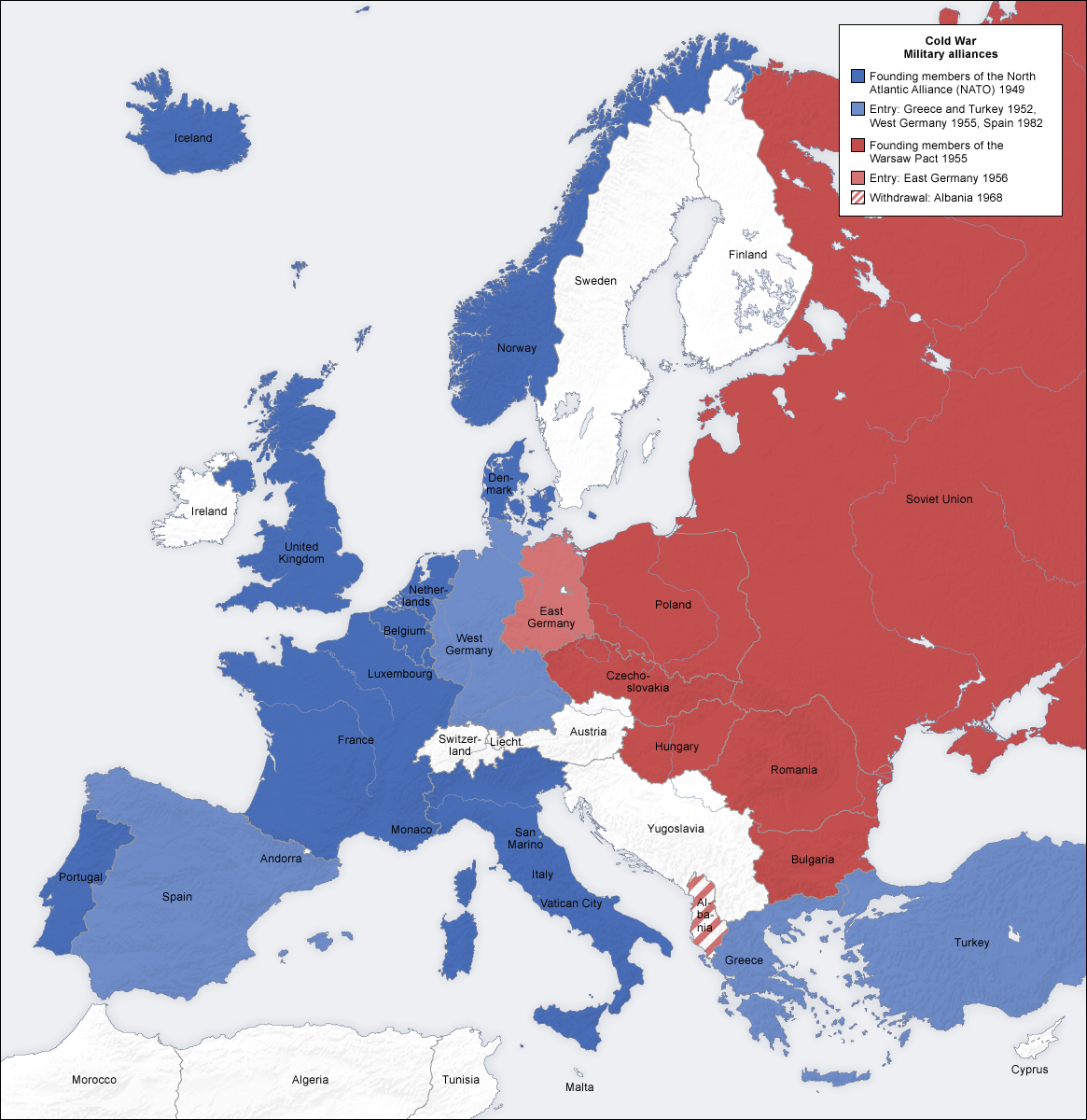
The Federal Republic of Germany was established in May 1949, followed by the German Democratic Republic in October. NATO, founded in April, linked North American and western European defence. The Warsaw Pact followed in 1955 after West Germany entered NATO. Occupation, political division and military alliances had become connected parts of the Cold War order.
Korea: the possibilities and limits of containment
After Japanese rule ended in 1945, Korea was divided into Soviet and American occupation areas near the thirty-eighth parallel. In 1948, separate governments emerged under Kim Il Sung in the north and Syngman Rhee in the south. Both claimed authority over the entire peninsula. The conflict therefore involved Korean ambitions as well as superpower rivalry.
North Korea invaded the south on 25 June 1950 with Soviet approval. Truman interpreted the attack as a test of containment, especially after the communist victory in China in 1949. The UN Security Council supported military assistance to South Korea while the USSR was boycotting its meetings. A multinational force, dominated by the United States, intervened under General Douglas MacArthur.
North Korean forces initially advanced almost to the southern port of Pusan. The UN landing at Inchon in September reversed the situation. After recovering the south, UN forces crossed into the north and advanced toward China. Chinese intervention then drove them back. A mission to defend South Korea had expanded into an attempt to reunify the peninsula and encountered a larger war.
Truman dismissed MacArthur in April 1951 amid disagreement over widening the conflict with China. Negotiations began in July 1951, but fighting continued. Eisenhower's election in 1952, Stalin's death in March 1953 and continuing military costs contributed to the context in which an armistice was signed on 27 July 1953.
South Korea survived outside communist rule, so containment achieved its original defensive objective. Reunification failed, millions suffered, and the peninsula remained divided near the original boundary. The armistice stopped the fighting without creating a final peace settlement. South Korea's government at the time was authoritarian, so its survival should not simply be described as an immediate victory for democracy.
The Berlin Wall and the human cost of division
Before 1961, Berlin offered an important route for East Germans to leave for the west. Millions departed after 1949, including many young and skilled workers. Emigration harmed the East German economy and challenged the government's legitimacy. Soviet and East German leaders also regarded West Berlin as a base for western influence and intelligence activity.
On 13 August 1961, East German authorities closed the border with Soviet support, initially using wire and barriers. The system developed into a fortified wall around West Berlin. Families were separated, ordinary journeys were interrupted and escape became dangerous. Guards used lethal force, and many people died at the border.
The Wall helped stabilise East Germany by stopping mass emigration, but made repression physically visible. In October 1961, American and Soviet tanks confronted each other at Checkpoint Charlie before withdrawing. The crisis demonstrated both the danger of direct conflict and the willingness of leaders to avoid escalation while accepting a divided city.
Cuba and nuclear confrontation
Fidel Castro's revolution overthrew Batista in Cuba in 1959. Nationalisation and worsening relations with the United States pushed Cuba toward the Soviet Union. The failed American-backed Bay of Pigs invasion in April 1961 reinforced Castro's fear of another attack. Soviet protection thus answered a Cuban security concern as well as serving Khrushchev's strategic interests.
In 1962, the USSR secretly deployed nuclear missiles to Cuba. Khrushchev hoped to protect the island and improve the Soviet strategic position, including in relation to American missiles in Turkey. American reconnaissance photographs taken on 14 October revealed missile sites; Kennedy was informed two days later. He considered options ranging from negotiation to air strikes and invasion, each carrying serious risks.
Kennedy announced a naval quarantine on 22 October. It was intended to block further offensive military supplies while leaving time for negotiation, but did not remove missiles already on the island. Confrontations at sea, continuing construction and the shooting down of an American U-2 aircraft on 27 October brought the crisis close to war.
The settlement combined public and private commitments. The USSR agreed to remove its missiles; the United States publicly promised not to invade Cuba and privately agreed to remove its Jupiter missiles from Turkey. Khrushchev announced the withdrawal on 28 October. Both governments could claim gains, while Cuba's leadership resented being excluded from the final negotiations.
The crisis encouraged efforts to reduce the danger of miscalculation. A direct communications link and the Partial Test Ban Treaty followed in 1963. The treaty prohibited nuclear testing in the atmosphere, underwater and in space, but not underground. Nuclear rivalry continued, so avoiding war in Cuba did not end the arms race.
Vietnam: decolonisation and American escalation
Vietnam's war grew from resistance to colonial rule as well as the Cold War. Ho Chi Minh declared independence in 1945, but France sought to restore its authority. After the French defeat at Dien Bien Phu in 1954, the Geneva settlement created a temporary military division near the seventeenth parallel and envisaged elections for reunification. Those elections did not take place.
The United States supported an anti-communist state in the south under Ngo Dinh Diem. His authoritarian government, favouritism and repression alienated opponents, including many Buddhists. Diem was overthrown and killed in 1963. American support could provide resources without creating a widely accepted or consistently effective government.
The National Liberation Front developed in the south, supported by North Vietnam. Its forces, commonly called the Viet Cong by their opponents, combined guerrilla tactics with political organisation; North Vietnamese regular forces also became increasingly important. Supplies moved along routes collectively known as the Ho Chi Minh Trail through neighbouring countries.
After the Gulf of Tonkin incidents in 1964, President Johnson obtained broad congressional authority and escalated the war. American combat troops arrived in large numbers from 1965, while Operation Rolling Thunder bombed North Vietnam. Helicopters, artillery, napalm and chemical defoliants gave the United States immense destructive power, but did not solve the political problem of securing durable support in South Vietnam.
Why American power did not secure victory
Guerrilla warfare made it difficult to distinguish combatants from civilians, while destructive operations could deepen hostility toward American and South Vietnamese forces. North Vietnam received assistance from both China and the USSR, despite tensions between those powers. Its leadership accepted very high costs in pursuit of victory.
The Tet Offensive of 1968 failed to achieve its immediate military objectives but shocked American public opinion by contradicting optimistic official claims. The My Lai massacre, committed by American soldiers in March 1968 and exposed publicly later, further damaged confidence. Television, photography and reporting brought the war into public debate, while casualties, conscription and doubts about purpose fuelled protest.
President Nixon pursued Vietnamisation from 1969, reducing American ground forces while increasing the responsibilities of the South Vietnamese army. The war also expanded into neighbouring areas and involved further heavy bombing. The Paris Peace Accords of January 1973 led to the withdrawal of remaining American combat forces, but did not create a lasting settlement between the Vietnamese sides.
North Vietnamese forces captured Saigon on 30 April 1975. Containment had failed to preserve an independent non-communist South Vietnam. Comparison with Korea shows that military resources alone did not determine outcomes: local political conditions, geography, outside support, leadership and willingness to sustain losses all mattered.
Arms, space and competition for prestige
The Soviet atomic test of 1949 ended the American nuclear monopoly. Both powers developed more destructive weapons and delivery systems. Deterrence rested on the fear that an attack would provoke devastating retaliation, but accidents and miscalculation remained dangers. Military spending also placed heavy demands on economies.
Space exploration became linked to this competition because rocket technology had both scientific and military applications. The USSR launched Sputnik, the first artificial satellite, in October 1957. Yuri Gagarin became the first human in space in 1961; Valentina Tereshkova became the first woman in 1963, and Alexei Leonov performed the first spacewalk in 1965.
American programmes responded with major investment. Apollo 8 orbited the Moon in 1968, and Apollo 11 landed Neil Armstrong and Buzz Aldrin there in July 1969 while Michael Collins remained in lunar orbit. The landing achieved Kennedy's declared goal and a major propaganda success. It did not mean that all space competition or Soviet scientific achievements ended at that moment.
Resistance to Soviet control in eastern Europe
Soviet control was repeatedly challenged. In East Germany in 1953, protests and strikes were suppressed with Soviet military force. In Hungary in 1956, the uprising and Imre Nagy's plans for political change and withdrawal from the Warsaw Pact prompted Soviet intervention. The defeat of the uprising revealed the limits Moscow would impose on independence.
In Czechoslovakia in 1968, Alexander Dubcek's Prague Spring sought reform within a socialist system, including greater freedom of expression. Warsaw Pact forces invaded in August. The resulting doctrine associated with Leonid Brezhnev asserted that threats to socialism in one state could justify intervention by others.
In Poland, the independent trade union Solidarity emerged in 1980 under Lech Walesa's leadership. It brought together economic grievances and demands for rights. The Polish government imposed martial law in December 1981 and suppressed the movement, but did not eliminate its social support. Opposition within eastern Europe remained an active force rather than merely a consequence of decisions made in Moscow.
Reform and the end of the Cold War
By the 1980s, the Soviet system faced economic stagnation, shortages, technological difficulties and costly military commitments, including the war in Afghanistan. These problems cannot be explained by claiming that every worker received identical pay or simply refused to work. Planning incentives, administrative rigidity, political repression and the burden of competition interacted in complex ways.
Mikhail Gorbachev became Soviet leader in 1985 and introduced perestroika, or restructuring, and glasnost, or greater openness. He intended to reform the system, but increased debate exposed grievances and weakened established authority. Negotiations with the United States reduced some tensions, while his refusal to maintain eastern European governments by military intervention changed their political prospects.
In 1989, negotiated changes and partly free elections in Poland, border openings in Hungary and mass protests elsewhere undermined communist rule. In East Germany, demonstrations and emigration created intense pressure. On 9 November, a confused announcement about travel regulations brought crowds to Berlin's checkpoints, and guards opened them. The Wall's opening resulted from both long-term pressures and immediate decisions.
Germany reunified on 3 October 1990. Within the USSR, economic crisis, national movements and struggles between reformers and hardliners continued. The failed coup against Gorbachev in August 1991 strengthened Boris Yeltsin and accelerated the break-up of the union. Gorbachev resigned in December and the USSR ceased to exist. The Cold War ended through interacting economic, political and social changes, rather than one leader or one event alone.
Revision questions
Write an answer before opening the explanation. Your answers stay in this browser.
01 Why did victory over Germany fail to preserve the American-Soviet alliance?
Read the explanation
At Yalta in February 1945, Roosevelt, Churchill and Stalin discussed Germany's defeat, occupation and the future of Europe. Agreements about representative government and elections concealed different understandings of what would follow. By the Potsdam Conference in July and August, Roosevelt had died and Truman had become president; Attlee replaced Churchill during the conference after Britain's election.
The USSR had suffered devastating destruction and approximately twenty-seven million deaths. Stalin sought reparations and a protective zone of friendly governments. The United States emerged with exceptional economic power and, initially, a monopoly on atomic weapons. Soviet security demands and American support for political and economic openness increasingly appeared threatening to one another.
02 How did disputes over Germany produce the Berlin Blockade, and what followed?
Read the explanation
The western powers moved toward economic integration of their zones and introduced a new currency in 1948. Stalin feared a strengthened western German state aligned with the United States. In June, Soviet authorities cut the principal land and water routes supplying the western sectors of Berlin. Air corridors remained available: the city was not sealed against every possible form of transport.
The western response was an airlift carrying food, fuel and other supplies. It sustained the population without a military attempt to force open the ground routes. The blockade ended in May 1949, having failed to remove the western powers from Berlin. The crisis deepened distrust and accelerated Europe's division.
The Federal Republic of Germany was established in May 1949, followed by the German Democratic Republic in October. NATO, founded in April, linked North American and western European defence. The Warsaw Pact followed in 1955 after West Germany entered NATO. Occupation, political division and military alliances had become connected parts of the Cold War order.
03 In what sense was Korea a success for containment, and what were its limits?
Read the explanation
North Korea invaded the south on 25 June 1950 with Soviet approval. Truman interpreted the attack as a test of containment, especially after the communist victory in China in 1949. The UN Security Council supported military assistance to South Korea while the USSR was boycotting its meetings. A multinational force, dominated by the United States, intervened under General Douglas MacArthur.
North Korean forces initially advanced almost to the southern port of Pusan. The UN landing at Inchon in September reversed the situation. After recovering the south, UN forces crossed into the north and advanced toward China. Chinese intervention then drove them back. A mission to defend South Korea had expanded into an attempt to reunify the peninsula and encountered a larger war.
Truman dismissed MacArthur in April 1951 amid disagreement over widening the conflict with China. Negotiations began in July 1951, but fighting continued. Eisenhower's election in 1952, Stalin's death in March 1953 and continuing military costs contributed to the context in which an armistice was signed on 27 July 1953.
South Korea survived outside communist rule, so containment achieved its original defensive objective. Reunification failed, millions suffered, and the peninsula remained divided near the original boundary. The armistice stopped the fighting without creating a final peace settlement. South Korea's government at the time was authoritarian, so its survival should not simply be described as an immediate victory for democracy.
04 How did the Cuban Missile Crisis develop and how was it resolved?
Read the explanation
In 1962, the USSR secretly deployed nuclear missiles to Cuba. Khrushchev hoped to protect the island and improve the Soviet strategic position, including in relation to American missiles in Turkey. American reconnaissance photographs taken on 14 October revealed missile sites; Kennedy was informed two days later. He considered options ranging from negotiation to air strikes and invasion, each carrying serious risks.
Kennedy announced a naval quarantine on 22 October. It was intended to block further offensive military supplies while leaving time for negotiation, but did not remove missiles already on the island. Confrontations at sea, continuing construction and the shooting down of an American U-2 aircraft on 27 October brought the crisis close to war.
The settlement combined public and private commitments. The USSR agreed to remove its missiles; the United States publicly promised not to invade Cuba and privately agreed to remove its Jupiter missiles from Turkey. Khrushchev announced the withdrawal on 28 October. Both governments could claim gains, while Cuba's leadership resented being excluded from the final negotiations.
The crisis encouraged efforts to reduce the danger of miscalculation. A direct communications link and the Partial Test Ban Treaty followed in 1963. The treaty prohibited nuclear testing in the atmosphere, underwater and in space, but not underground. Nuclear rivalry continued, so avoiding war in Cuba did not end the arms race.
05 Why did American military power fail to preserve South Vietnam?
Read the explanation
The Tet Offensive of 1968 failed to achieve its immediate military objectives but shocked American public opinion by contradicting optimistic official claims. The My Lai massacre, committed by American soldiers in March 1968 and exposed publicly later, further damaged confidence. Television, photography and reporting brought the war into public debate, while casualties, conscription and doubts about purpose fuelled protest.
President Nixon pursued Vietnamisation from 1969, reducing American ground forces while increasing the responsibilities of the South Vietnamese army. The war also expanded into neighbouring areas and involved further heavy bombing. The Paris Peace Accords of January 1973 led to the withdrawal of remaining American combat forces, but did not create a lasting settlement between the Vietnamese sides.
North Vietnamese forces captured Saigon on 30 April 1975. Containment had failed to preserve an independent non-communist South Vietnam. Comparison with Korea shows that military resources alone did not determine outcomes: local political conditions, geography, outside support, leadership and willingness to sustain losses all mattered.
06 What do Hungary, Czechoslovakia and Poland reveal about resistance to Soviet control?
Read the explanation
In Czechoslovakia in 1968, Alexander Dubcek's Prague Spring sought reform within a socialist system, including greater freedom of expression. Warsaw Pact forces invaded in August. The resulting doctrine associated with Leonid Brezhnev asserted that threats to socialism in one state could justify intervention by others.
In Poland, the independent trade union Solidarity emerged in 1980 under Lech Walesa's leadership. It brought together economic grievances and demands for rights. The Polish government imposed martial law in December 1981 and suppressed the movement, but did not eliminate its social support. Opposition within eastern Europe remained an active force rather than merely a consequence of decisions made in Moscow.
07 How did reform, popular pressure and economic problems combine to end the Cold War?
Read the explanation
Mikhail Gorbachev became Soviet leader in 1985 and introduced perestroika, or restructuring, and glasnost, or greater openness. He intended to reform the system, but increased debate exposed grievances and weakened established authority. Negotiations with the United States reduced some tensions, while his refusal to maintain eastern European governments by military intervention changed their political prospects.
In 1989, negotiated changes and partly free elections in Poland, border openings in Hungary and mass protests elsewhere undermined communist rule. In East Germany, demonstrations and emigration created intense pressure. On 9 November, a confused announcement about travel regulations brought crowds to Berlin's checkpoints, and guards opened them. The Wall's opening resulted from both long-term pressures and immediate decisions.
Germany reunified on 3 October 1990. Within the USSR, economic crisis, national movements and struggles between reformers and hardliners continued. The failed coup against Gorbachev in August 1991 strengthened Boris Yeltsin and accelerated the break-up of the union. Gorbachev resigned in December and the USSR ceased to exist. The Cold War ended through interacting economic, political and social changes, rather than one leader or one event alone.