Rome developed beside the Tiber in Latium, central Italy, during the first millennium BCE. Roman accounts explained its beginnings through stories of divine ancestry, heroic journeys and violent conflict. Archaeology reveals a different kind of evidence: settlements, objects and public works. Studying Rome’s origins requires comparing these sources without assuming that a traditional story is either a literal record or historically meaningless.
Aeneas and the connection with Troy
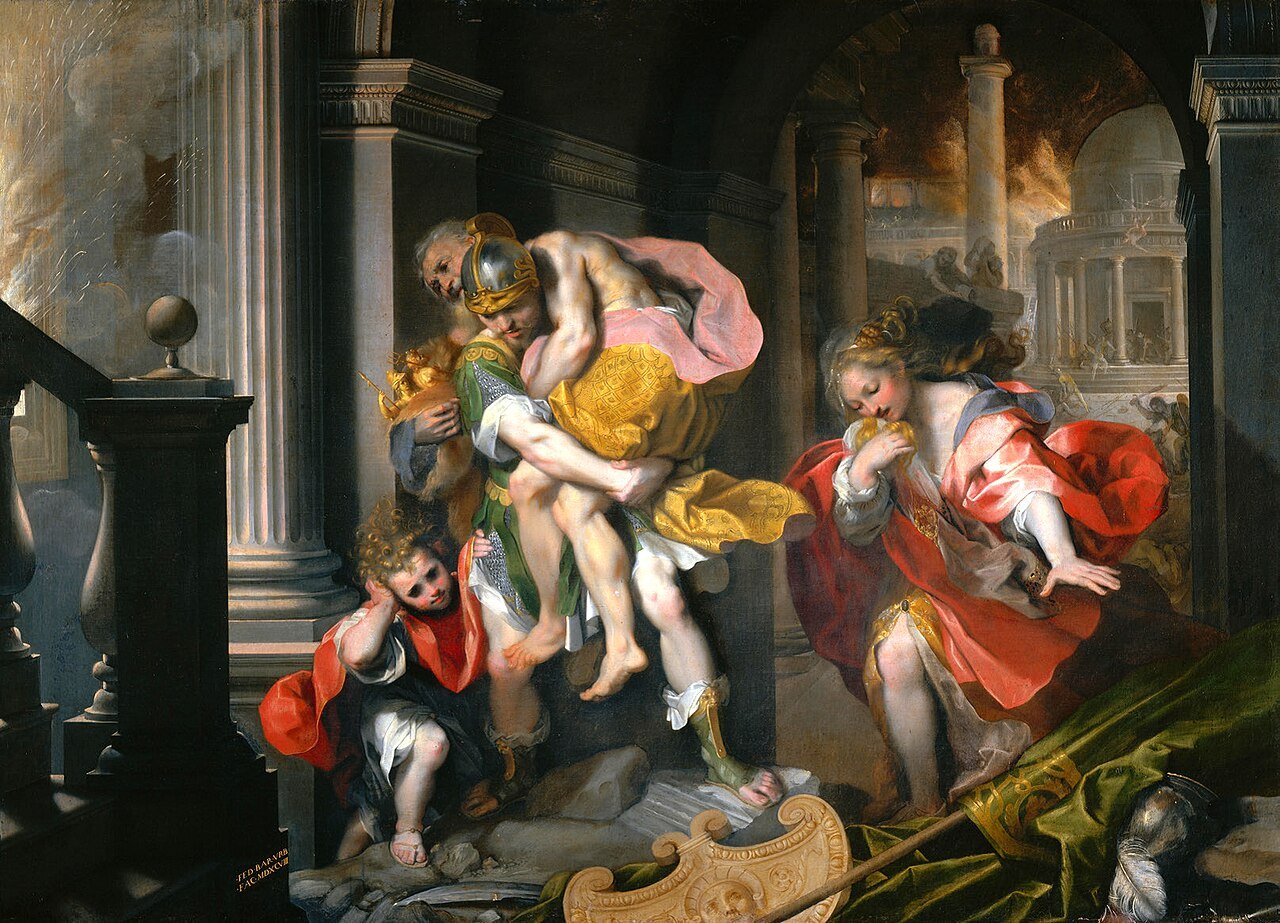
In Roman tradition, Aeneas was a Trojan hero and the son of Venus. Escaping the destruction of Troy, he travelled to Italy, where his descendants were linked to the communities from which Rome emerged. His son Ascanius, also called Iulus, connected this story to Alba Longa and later Roman family traditions.
Virgil’s Aeneid, composed in the first century BCE, gave this journey an influential literary form. It was written many centuries after the events it described, in a world shaped by Augustus’ power. The story connected Rome to the prestigious heroic past of the Greeks while presenting Roman history as a journey towards a larger destiny.
Romulus, Remus and the foundation story
The twins Romulus and Remus were said to be sons of Rhea Silvia and Mars. Abandoned near the Tiber, they survived with the help of a she-wolf and were raised by a shepherd. As adults, they became involved in a struggle over power and the founding of a new settlement. Different versions explain Remus’ death differently, but Romulus emerges as Rome’s founder.
Roman tradition dated the foundation to 753 BCE. Stories about birds interpreted as divine signs, or auspices, connected political authority with religion. The tale also made conflict between relatives part of Rome’s earliest identity. A precise traditional date does not prove that a city appeared fully formed on one day.
The Sabines and the integration of communities
Another foundation narrative described the seizure of Sabine women by Romulus’ followers. War followed between their relatives and the Romans. The women were then said to have intervened between the armies, leading to reconciliation and the union of the communities.
The story contains violence and coercion, not simply a peaceful account of marriage. At the same time, it offered Romans a way to explain how outsiders became part of their community. Later artists repeatedly represented the episode, showing how ancient stories could be reinterpreted to discuss conflict and reconciliation in other periods.
What archaeology establishes
Traces of early dwellings on Rome’s hills, including the Palatine, show settlement during the first millennium BCE. Their development took place within an Italian world containing Latins, Sabines, Etruscans and Greek communities. Rome’s position near a river crossing encouraged movement and exchange. Its growth involved connections among settlements rather than only the actions of one founder.
Etruscan influence was important in the development of early urban institutions and monumental construction. The draining and organisation of the forum area, temples and other works reveal increasing collective resources. Archaeological structures were often rebuilt over centuries, so their surviving forms cannot automatically be assigned to one named legendary king.
From monarchy to Republic
Roman tradition named seven kings and described the expulsion of the last, Tarquin the Proud, in 509 BCE. The transition to the Republic placed authority in institutions including magistrates, assemblies and the Senate rather than in a permanent king. The earliest narrative details remain difficult to verify because surviving literary accounts were written much later.
The Republic was not a modern democracy with equal political power for every resident. Status, wealth, gender and freedom shaped participation. Nevertheless, opposition to kingship became a strong theme in Roman political language, and later leaders had to explain their authority in relation to republican traditions.
Myths as instruments of power
Images of Aeneas, the twins and the she-wolf appeared on coins, paintings and monuments. Roman religion also identified local deities with Greek counterparts, such as Jupiter with Zeus and Venus with Aphrodite, while retaining distinctive Roman practices. These connections were adaptations rather than the simple replacement of one complete religion by another.
Julius Caesar claimed descent from Venus through Iulus and Aeneas. Coins and his temple of Venus Genetrix associated his family with Rome’s sacred beginnings. Such claims show why myths matter to historians: even when they cannot establish an event’s factual details, they reveal how people understood identity, ancestry and legitimate power.
Revision questions
Write an answer before opening the explanation. Your answers stay in this browser.
01 Why did Roman tradition connect Aeneas with Troy?
Read the explanation
Virgil’s Aeneid, composed in the first century BCE, gave this journey an influential literary form. It was written many centuries after the events it described, in a world shaped by Augustus’ power. The story connected Rome to the prestigious heroic past of the Greeks while presenting Roman history as a journey towards a larger destiny.
02 What does the story of Romulus and Remus explain about Rome's imagined origins?
Read the explanation
Roman tradition dated the foundation to 753 BCE. Stories about birds interpreted as divine signs, or auspices, connected political authority with religion. The tale also made conflict between relatives part of Rome’s earliest identity. A precise traditional date does not prove that a city appeared fully formed on one day.
03 How does archaeological evidence differ from a foundation myth?
Read the explanation
Etruscan influence was important in the development of early urban institutions and monumental construction. The draining and organisation of the forum area, temples and other works reveal increasing collective resources. Archaeological structures were often rebuilt over centuries, so their surviving forms cannot automatically be assigned to one named legendary king.
04 How could Rome's rulers use origin stories to support their authority?
Read the explanation
Julius Caesar claimed descent from Venus through Iulus and Aeneas. Coins and his temple of Venus Genetrix associated his family with Rome’s sacred beginnings. Such claims show why myths matter to historians: even when they cannot establish an event’s factual details, they reveal how people understood identity, ancestry and legitimate power.