Christianity began within the Jewish world of the eastern Roman Empire in the first century CE. Its followers identified Jesus of Nazareth as the Messiah and believed that he had risen from the dead. From small communities in Judaea and neighbouring regions, the movement spread around the Mediterranean. Understanding its origins requires a distinction between the beliefs of Christians and the evidence historians use to reconstruct the past.
Jesus in the Jewish and Roman world
Jesus lived in a region shaped by Jewish religious traditions and Roman imperial power. Galilee and Judaea did not have identical political arrangements, but both belonged to Rome's sphere of control. Jewish people worshipped one God, studied sacred writings and attached particular importance to the Temple in Jerusalem. They disagreed among themselves about religious authority and how to respond to foreign rule.
Jesus taught about the kingdom of God and gathered disciples. The Gospels describe his teaching through speeches, parables and accounts of healing. Historians read these works as religious texts written by early Christians, not as modern biographies or neutral transcripts. They provide essential evidence about what Christian communities believed, while raising questions about how particular events were remembered.
Jesus was crucified under the Roman governor Pontius Pilate, around 30 CE. Crucifixion was a Roman punishment associated especially with slaves and people regarded as threats to authority. His death should not be attributed collectively to Jewish people. His first followers were themselves Jewish, and the circumstances involved the institutions and conflicts of a particular Roman province.
From Jesus to the first Christian communities
The disciples' belief that Jesus had risen from the dead transformed the meaning of his execution. For Christians, the resurrection showed that death had not defeated him and confirmed his role in God's plan of salvation. This is a statement of faith; historians can investigate the emergence and spread of that belief without claiming to prove a miracle.
The apostles carried their message beyond Jesus' original followers. Paul, a Jewish man from Tarsus who became a Christian missionary, was particularly important in establishing communities outside Judaea. His journeys and letters helped address a central question: did non-Jewish converts need to follow all the requirements of Jewish religious law? The growing inclusion of these converts helped Christianity become a distinct religion over time.
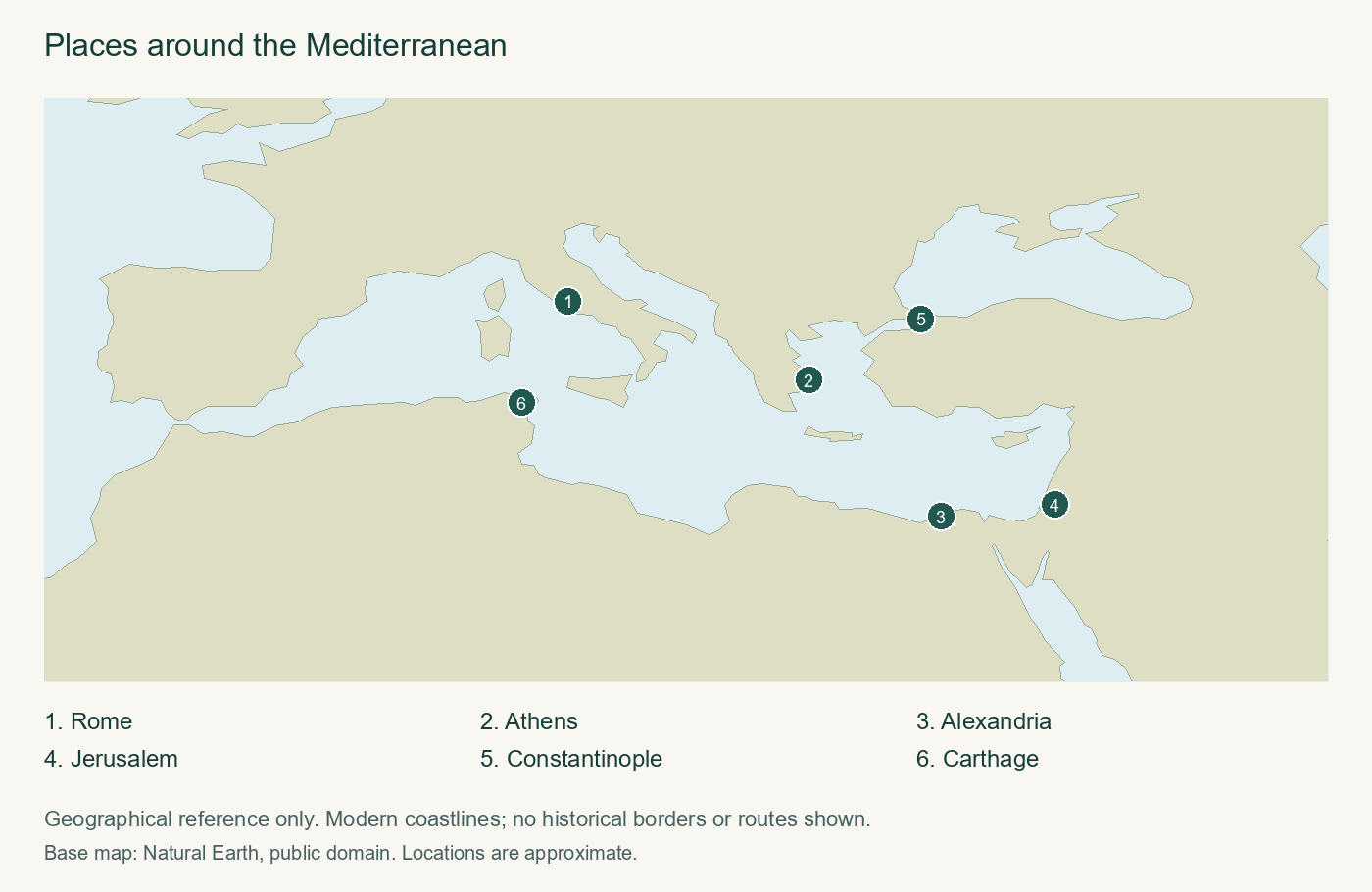
Roman roads, sea routes and the widespread use of Greek connected towns across the eastern Mediterranean. Travellers, merchants and missionaries could therefore carry religious ideas between communities. Expansion was gradual and uneven, rather than an immediate conversion of the empire.
Scriptures, worship and belonging
The Christian Bible contains an Old Testament, drawing on Jewish scriptures, and a New Testament. The latter includes four Gospels, the Acts of the Apostles, letters and Revelation. These writings were composed at different times and served different purposes. Paul's letters, for example, often respond to practical disputes within particular communities.
Baptism marked entry into Christian life. The shared meal known as the Eucharist recalled Jesus' last meal with his disciples and acquired a central place in worship. Christians gathered for prayer, readings and the support of fellow believers. Sunday became particularly important because of its association with the resurrection.
Communities gradually developed more formal leadership. Bishops oversaw local churches, supported by other ministers. Shared beliefs and practices connected these churches, but early Christians still disagreed about doctrine, authority and how to live within Roman society.
From a minority religion to imperial recognition
Christians sometimes faced suspicion because they refused sacrifices to traditional gods or the emperor's divine status. Roman authorities could interpret this refusal as a challenge to public order. Persecution varied greatly by place and period; Christians were not hunted continuously throughout the first three centuries. Catacombs were principally burial places, rather than evidence that all Christian worship took place underground.
The position of Christianity changed dramatically in the fourth century. Constantine and Licinius agreed to religious toleration in 313. Constantine subsequently supported the Church and convened the Council of Nicaea in 325 to address disputes about Christian belief. In 380, Theodosius I and his fellow emperors endorsed Nicene Christianity as imperial orthodoxy; further restrictions on traditional cults followed. These developments turned a once vulnerable minority religion into an institution closely connected with imperial power.
Revision questions
Write an answer before opening the explanation. Your answers stay in this browser.
01 Place Jesus in his Jewish and Roman historical context.
Read the explanation
Jesus taught about the kingdom of God and gathered disciples. The Gospels describe his teaching through speeches, parables and accounts of healing. Historians read these works as religious texts written by early Christians, not as modern biographies or neutral transcripts. They provide essential evidence about what Christian communities believed, while raising questions about how particular events were remembered.
Jesus was crucified under the Roman governor Pontius Pilate, around 30 CE. Crucifixion was a Roman punishment associated especially with slaves and people regarded as threats to authority. His death should not be attributed collectively to Jewish people. His first followers were themselves Jewish, and the circumstances involved the institutions and conflicts of a particular Roman province.
02 How did Paul and Mediterranean networks help Christianity spread?
Read the explanation
Roman roads, sea routes and the widespread use of Greek connected towns across the eastern Mediterranean. Travellers, merchants and missionaries could therefore carry religious ideas between communities. Expansion was gradual and uneven, rather than an immediate conversion of the empire.
03 Explain the roles of scripture, baptism and the Eucharist in Christian communities.
Read the explanation
Baptism marked entry into Christian life. The shared meal known as the Eucharist recalled Jesus' last meal with his disciples and acquired a central place in worship. Christians gathered for prayer, readings and the support of fellow believers. Sunday became particularly important because of its association with the resurrection.
Communities gradually developed more formal leadership. Bishops oversaw local churches, supported by other ministers. Shared beliefs and practices connected these churches, but early Christians still disagreed about doctrine, authority and how to live within Roman society.
04 How did Christianity's relationship with Roman power change by the fourth century?
Read the explanation
The position of Christianity changed dramatically in the fourth century. Constantine and Licinius agreed to religious toleration in 313. Constantine subsequently supported the Church and convened the Council of Nicaea in 325 to address disputes about Christian belief. In 380, Theodosius I and his fellow emperors endorsed Nicene Christianity as imperial orthodoxy; further restrictions on traditional cults followed. These developments turned a once vulnerable minority religion into an institution closely connected with imperial power.