The Neolithic was a period of major changes in food production, settlement and social life. Communities increasingly cultivated plants and raised animals, built enduring villages and developed new crafts. “Neolithic Revolution” describes the scale of the transformation, not a sudden event experienced everywhere at the same time. Hunting and gathering continued alongside farming, and different regions followed different paths.
Producing food and living in villages
In Southwest Asia, cultivation and animal management expanded from around the tenth millennium BCE. Wheat, barley, lentils and peas became important crops, while sheep, goats, cattle and pigs were gradually domesticated. Cultivation involved sowing and tending plants; domestication involved inherited changes across generations. Food production could make supplies more predictable, but also increased dependence on harvests and the labour needed to maintain them.
Stored grain helped feed people between harvests and encouraged investment in buildings. Yet settlement did not simply begin after farming: some hunter-gatherers had already stayed in one place for extended periods. Rivers and springs offered drinking water, fish, transport and access to productive land. The relationship between settlement and food production was therefore one of mutual reinforcement rather than a fixed sequence.
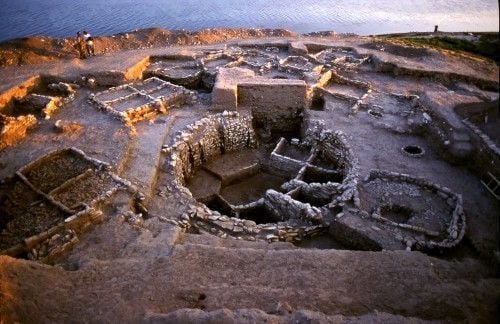
Jerf el Ahmar on the Euphrates, occupied around 9500-8700 BCE, contained houses and large communal structures. Shared storage and food preparation suggest cooperation beyond individual households. Much later, the settlement of Kervouric in Brittany, around 4800 BCE, included long houses of timber and wattle and daub. These examples show that village life took different architectural forms as farming spread.
Tools, crafts and exchange
Farming required equipment for clearing ground, harvesting and processing grain. Polished stone axes helped fell trees; sickles combined handles with sharp flint blades; querns ground cereals into flour. Storage pits and containers protected food. Pottery became important in many Neolithic communities, although early farmers in Southwest Asia lived before its widespread adoption. Spinning and weaving gradually expanded the use of plant and animal fibres.
Crafts also encouraged exchange between communities. Materials and finished objects could travel beyond the places where they were produced. Metallurgy developed unevenly: copper was worked before bronze, an alloy usually combining copper and tin. Copper weapons from Arslantepe, dating to the late fourth millennium BCE, illustrate later technological developments rather than the beginning of the Neolithic itself.
Wealth, authority and conflict
Stored resources, livestock and valuable objects could be distributed unequally. Some burials contain far more goods than others, suggesting differences in social position. At Varna in Bulgaria, graves from the fifth millennium BCE include remarkable gold objects. The richly furnished burial known as Grave 43 provides evidence of unequal access to prestige goods.
Such discoveries do not prove that every farming village was ruled by a chief. Political arrangements varied, and rich graves require interpretation. Settled communities could cooperate over construction and irrigation, compete over land or resources, and experience violence. Farming created new opportunities for wealth and power without producing one identical social system everywhere.
Several centres and routes of expansion
Agriculture did not spread from a single origin to the entire world. Southwest Asia developed wheat- and barley-based systems; different parts of China cultivated rice and millet. New Guinea, the Americas and parts of Africa developed other combinations. Maize, beans and squash were important in Mesoamerica, while potatoes and camelids formed part of Andean food production.
Within Europe, farming spread through the movement of people and the exchange of knowledge. Routes followed the Mediterranean and the Danube basin. Farming communities were established in Greece around the seventh millennium BCE, reached parts of France during the sixth millennium and appeared in Britain around 4000 BCE. These broad dates describe a gradual process with considerable local variation.
Monuments and beliefs
Communities made figurines, decorated objects and monumental constructions. Human-like sculptures, including statue-menhirs such as the Dame de Saint-Sernin, suggest symbolic ways of representing people or other beings. Their identification as particular gods is often uncertain because no written explanation survives.
Megaliths are monuments built with large stones. Menhirs are standing stones, while many dolmens formed parts of burial structures. The alignments of Carnac and the successive building phases of Stonehenge demonstrate planning and collective labour. Stonehenge’s earthwork began around 3000 BCE, with major stone settings added later; aspects of its layout relate to the movement of the Sun. Such monuments connect social organisation, memory and ritual, showing that the Neolithic transformation concerned much more than a change of diet.
Revision questions
Write an answer before opening the explanation. Your answers stay in this browser.
01 How did farming and herding change settlement and everyday life?
Read the explanation
Stored grain helped feed people between harvests and encouraged investment in buildings. Yet settlement did not simply begin after farming: some hunter-gatherers had already stayed in one place for extended periods. Rivers and springs offered drinking water, fish, transport and access to productive land. The relationship between settlement and food production was therefore one of mutual reinforcement rather than a fixed sequence.
Jerf el Ahmar on the Euphrates, occupied around 9500-8700 BCE, contained houses and large communal structures. Shared storage and food preparation suggest cooperation beyond individual households. Much later, the settlement of Kervouric in Brittany, around 4800 BCE, included long houses of timber and wattle and daub. These examples show that village life took different architectural forms as farming spread.
02 Explain the connections between new tools, crafts and exchange.
Read the explanation
Crafts also encouraged exchange between communities. Materials and finished objects could travel beyond the places where they were produced. Metallurgy developed unevenly: copper was worked before bronze, an alloy usually combining copper and tin. Copper weapons from Arslantepe, dating to the late fourth millennium BCE, illustrate later technological developments rather than the beginning of the Neolithic itself.
03 How could differences in wealth develop within farming societies?
Read the explanation
Such discoveries do not prove that every farming village was ruled by a chief. Political arrangements varied, and rich graves require interpretation. Settled communities could cooperate over construction and irrigation, compete over land or resources, and experience violence. Farming created new opportunities for wealth and power without producing one identical social system everywhere.
04 What do large Neolithic monuments suggest about communities and beliefs?
Read the explanation
Megaliths are monuments built with large stones. Menhirs are standing stones, while many dolmens formed parts of burial structures. The alignments of Carnac and the successive building phases of Stonehenge demonstrate planning and collective labour. Stonehenge’s earthwork began around 3000 BCE, with major stone settings added later; aspects of its layout relate to the movement of the Sun. Such monuments connect social organisation, memory and ritual, showing that the Neolithic transformation concerned much more than a change of diet.