During the first millennium BCE, Greek-speaking communities developed across the Aegean and the wider Mediterranean. They shared religious traditions, stories and forms of cultural life, but did not form a single country. Their principal political communities were poleis, or city-states, each combining an urban centre with its territory and institutions.
Geography and the organisation of the polis
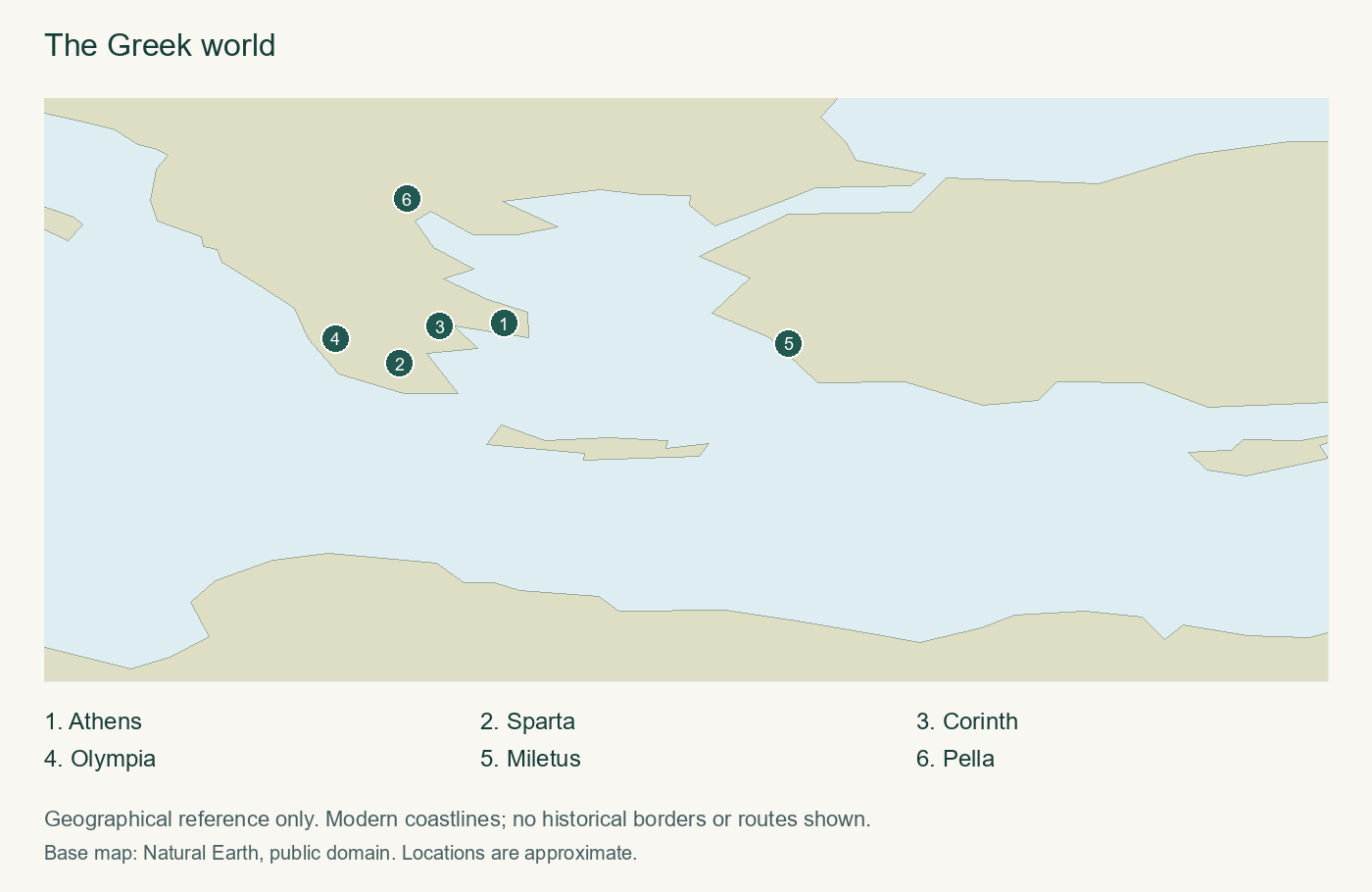
Mountains divided much of the Greek mainland into valleys and plains, while islands and coastlines connected communities by sea. Land suitable for cultivation was limited in many places. These conditions encouraged maritime exchange and regional differences, but geography alone did not determine political organisation: decisions, conflicts and historical traditions also mattered.
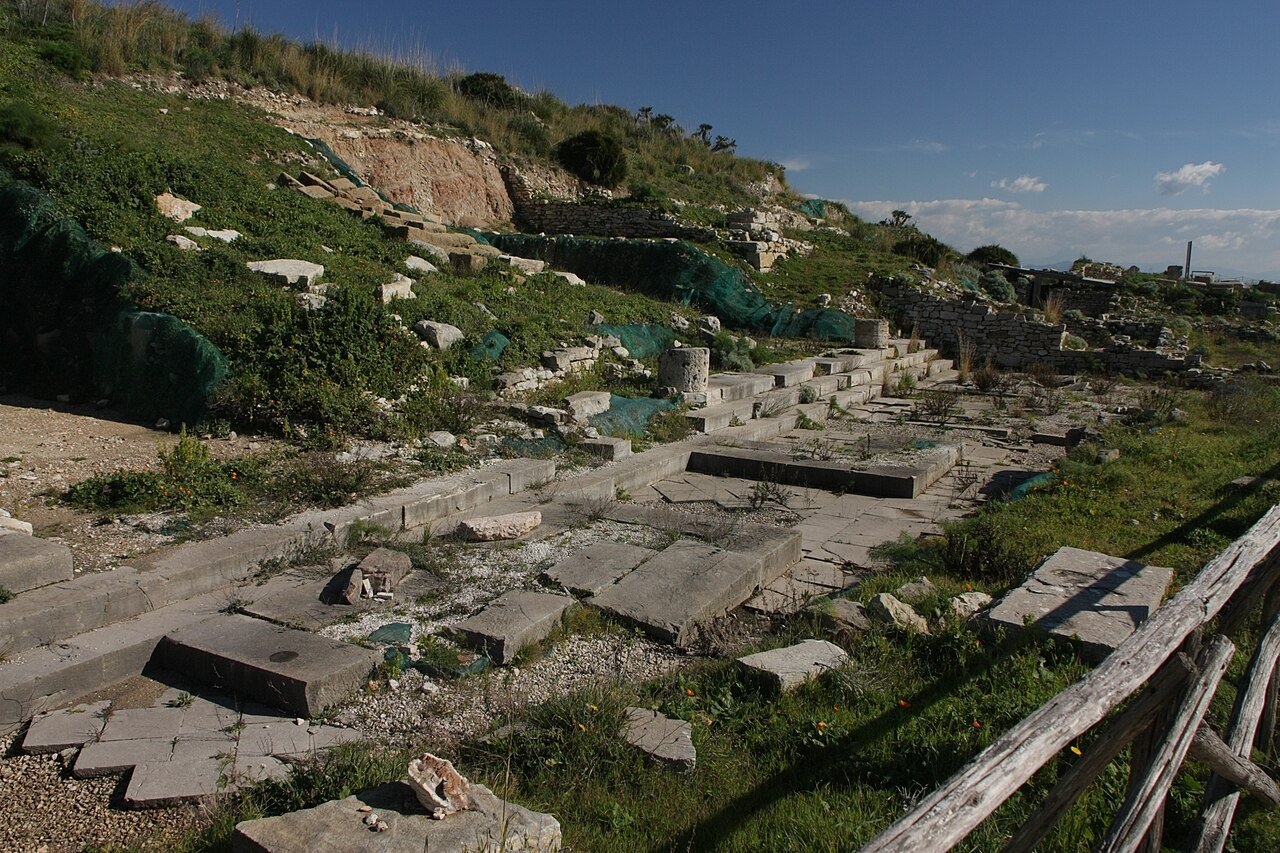
A polis governed its countryside as well as its town. Athens controlled Attica, while Sparta dominated Laconia and neighbouring territories. The agora provided space for markets, public discussion and civic activities. An acropolis could serve as a fortified height and religious centre; at Athens it became especially associated with Athena. Walls, ports, theatres and sanctuaries developed differently in different cities rather than following one compulsory plan.
Shared language, religion and stories
Greeks spoke related dialects and used alphabetic writing adapted from Phoenician traditions. Stories associated with Homer formed an important part of education and cultural memory. The Iliad explores a particular episode within the Trojan War tradition, especially Achilles’ anger; the Odyssey follows Odysseus’ difficult return home. Other episodes, including the fall of Troy, belonged to a wider body of stories rather than all appearing in the Iliad.
Greek religion was polytheistic. Gods such as Zeus, Hera, Athena, Apollo and Poseidon were honoured through offerings, sacrifices and festivals. Cities emphasised particular protective deities while participating in broader traditions. Myths about heroes, including Herakles, appeared in poetry, sculpture and painted pottery. They expressed ideas about courage, conflict and relations between humans and gods.
Sanctuaries and education
Panhellenic sanctuaries connected people from different Greek communities. Olympia hosted games in honour of Zeus, while Delphi was associated with Apollo and the oracle delivered through the Pythia. Festivals allowed competition, consultation and shared worship. The Olympic truce was intended to protect participation and travel, not to end every war throughout the Greek world.
Education depended on place, wealth, gender and status. Athletic training, music, poetry and preparation for civic or military duties were important in different combinations. Sparta’s training system for male citizens was distinctive. It would therefore be misleading to describe every Greek child as following one identical school programme or enjoying equal opportunities.
Different forms of government
Greek cities experimented with monarchy, aristocracy, oligarchy, tyranny and democracy. Monarchy placed authority in a king; oligarchy restricted power to a relatively small group. Tyrants obtained personal power outside established arrangements, although the ancient term does not exactly match every modern use of “tyrant”. Governments could change through conflict and reform.
Athens developed direct political participation for male citizens, while Sparta combined two kings with councils and other offices. Neither system included everyone living in its territory. Women, enslaved people and many resident foreigners lacked the political rights of male citizens. Citizenship described membership in a political community, not simply residence in a town.
War, alliances and settlement overseas
Hoplites were heavily equipped infantrymen who fought in close formations called phalanxes. Their shields and coordinated movement made cooperation essential. Cities fought one another and formed shifting alliances. During the Persian Wars, some cooperated against Persian invasions: Marathon in 490 BCE, Salamis in 480 and Plataea in 479 became major points of reference. Not all Greek communities took the same side.
Between the eighth and sixth centuries BCE, Greeks established settlements around the Mediterranean and Black Sea. Land shortages, political disputes and trading opportunities encouraged migration. A new settlement usually became an independent community while maintaining religious or cultural ties with its metropolis, or mother city; it did not necessarily retain the same government.
Massalia, later Marseille, was founded by settlers from Phocaea around 600 BCE. Its port linked Greek merchants with communities in Gaul. Such settlements widened the Greek world through contact and exchange, but also through competition and conflict with existing populations. Greek cultural connections therefore coexisted with strong local identities and political division.
Revision questions
Write an answer before opening the explanation. Your answers stay in this browser.
01 What was a polis, and how did geography affect Greek communities?
Read the explanation
A polis governed its countryside as well as its town. Athens controlled Attica, while Sparta dominated Laconia and neighbouring territories. The agora provided space for markets, public discussion and civic activities. An acropolis could serve as a fortified height and religious centre; at Athens it became especially associated with Athena. Walls, ports, theatres and sanctuaries developed differently in different cities rather than following one compulsory plan.
02 What connected Greeks who lived in different city-states?
Read the explanation
Greek religion was polytheistic. Gods such as Zeus, Hera, Athena, Apollo and Poseidon were honoured through offerings, sacrifices and festivals. Cities emphasised particular protective deities while participating in broader traditions. Myths about heroes, including Herakles, appeared in poetry, sculpture and painted pottery. They expressed ideas about courage, conflict and relations between humans and gods.
03 Why should Greek city-states not all be described as democracies?
Read the explanation
Athens developed direct political participation for male citizens, while Sparta combined two kings with councils and other offices. Neither system included everyone living in its territory. Women, enslaved people and many resident foreigners lacked the political rights of male citizens. Citizenship described membership in a political community, not simply residence in a town.
04 How did warfare and overseas settlement connect and divide the Greek world?
Read the explanation
Between the eighth and sixth centuries BCE, Greeks established settlements around the Mediterranean and Black Sea. Land shortages, political disputes and trading opportunities encouraged migration. A new settlement usually became an independent community while maintaining religious or cultural ties with its metropolis, or mother city; it did not necessarily retain the same government.
Massalia, later Marseille, was founded by settlers from Phocaea around 600 BCE. Its port linked Greek merchants with communities in Gaul. Such settlements widened the Greek world through contact and exchange, but also through competition and conflict with existing populations. Greek cultural connections therefore coexisted with strong local identities and political division.