The Roman Empire brought much of the Mediterranean and neighbouring regions under a government centred on the emperor. Its power depended on conquest, taxation, armies and cooperation with local elites. Imperial rule also encouraged exchange and the spread of institutions, without making every population culturally identical. The relationship between central authority and provincial diversity is essential to understanding the Roman world.
Augustus and the concentration of power
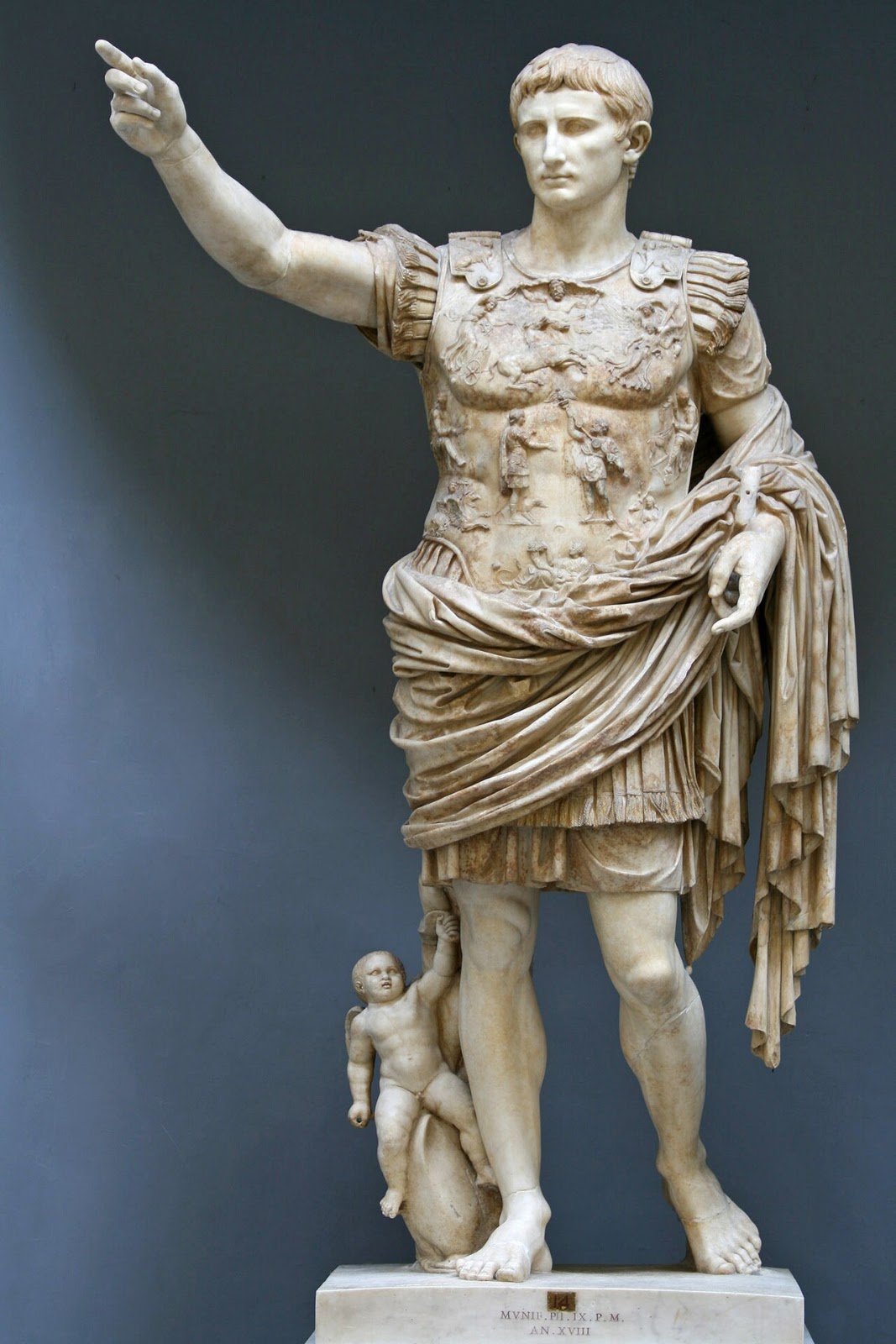
Julius Caesar’s assassination in 44 BCE was followed by further civil wars. His adopted heir Octavian eventually defeated Antony and Cleopatra at Actium in 31 BCE. In 27 BCE, the Senate granted him the name Augustus. This settlement conventionally marks the beginning of the imperial system known as the Principate.
Augustus retained republican offices and presented himself as princeps, the leading citizen. In practice, control of major armies, resources and political appointments gave him exceptional power. Religious authority reinforced his position: he became pontifex maximus in 12 BCE. His Res Gestae presented his achievements favourably and must be read as a statement of authority rather than a neutral autobiography.
Succession and the representation of authority
There was no permanently secure rule of imperial succession. Family relationships, adoption, senatorial acceptance and military support could all matter. Tiberius followed Augustus, and the Julio-Claudian dynasty continued through Caligula, Claudius and Nero. Nero’s death in 68 CE exposed the possibility of violent competition for power.
Monuments, statues, ceremonies and coins made the emperor visible across a vast territory. Victory arches and images on money promoted military success, family continuity and public generosity. The imperial cult linked loyalty to religious observance, although practices differed between communities and between honours offered to living and deceased rulers.
Provinces, frontiers and the Roman peace
Rome governed conquered territories through provinces, governors and local institutions. Italy initially held a different status. Armies protected routes, suppressed resistance and fought beyond the frontiers. Under Trajan, conquests in Dacia and the East brought the empire to its greatest territorial extent around 117 CE, although some eastern gains were soon relinquished.
The limes was a frontier zone rather than one continuous wall around the empire. Forts, roads, rivers and, in some places, barriers controlled movement. Hadrian’s Wall, begun in 122 in Britain, is a prominent example. The expression Pax Romana describes a period of relative imperial stability, especially during the first two centuries CE; it does not mean that warfare, rebellion or coercion disappeared.
Trade, communications and unequal labour
Sea routes carried grain from Egypt and North Africa, oil from several western provinces and wine from different producing regions. Roads served armies, officials and commerce, while milestones and maintained routes supported communication. Luxury goods also arrived through networks reaching India, Central Asia and China, usually involving many intermediaries.
Trade and urban prosperity rested on unequal labour systems. Enslaved people worked in domestic service, agriculture, workshops and mines. Free labourers and tenant farmers also supported production. Roman economic life cannot therefore be understood only through the comfort of wealthy households or the scale of surviving monuments.
Rome and the provincial cities
Rome’s population required extensive supplies of food and water. Grain arrived through its port system near the mouth of the Tiber; aqueducts supplied fountains, baths and other facilities. Forums combined religious, legal and political activities. The Colosseum hosted spectacles, while the Circus Maximus was associated with chariot racing. Public provision helped rulers demonstrate generosity and maintain support.
Provincial towns adopted elements of this urban culture, including forums, baths and temples. Some had regular street plans, but not every settlement contained every Roman building. Local elites often funded construction and held municipal offices, connecting their own prestige with participation in imperial society.
Citizenship and cultural change
Roman citizenship expanded through grants to individuals, communities and certain veterans. In 212 CE, Caracalla extended it to almost all free inhabitants of the empire. Citizenship conferred legal status and privileges, but its practical meaning changed over time; possession of it under an emperor did not mean equal influence over imperial decisions.
“Romanisation” describes the spread and adaptation of Roman institutions, language and practices. Latin became influential in the West, while Greek remained important in the East. Local religious traditions continued and could be associated with Roman gods; Romans themselves adopted cults from other regions. Becoming Roman was therefore an uneven process of participation, adaptation and sometimes resistance, rather than the disappearance of every earlier identity.
Revision questions
Write an answer before opening the explanation. Your answers stay in this browser.
01 How did Augustus concentrate power while preserving republican forms?
Read the explanation
Augustus retained republican offices and presented himself as princeps, the leading citizen. In practice, control of major armies, resources and political appointments gave him exceptional power. Religious authority reinforced his position: he became pontifex maximus in 12 BCE. His Res Gestae presented his achievements favourably and must be read as a statement of authority rather than a neutral autobiography.
02 Why did Roman peace still depend on military force?
Read the explanation
The limes was a frontier zone rather than one continuous wall around the empire. Forts, roads, rivers and, in some places, barriers controlled movement. Hadrian’s Wall, begun in 122 in Britain, is a prominent example. The expression Pax Romana describes a period of relative imperial stability, especially during the first two centuries CE; it does not mean that warfare, rebellion or coercion disappeared.
03 How were trade and transport connected with inequality and labour?
Read the explanation
Trade and urban prosperity rested on unequal labour systems. Enslaved people worked in domestic service, agriculture, workshops and mines. Free labourers and tenant farmers also supported production. Roman economic life cannot therefore be understood only through the comfort of wealthy households or the scale of surviving monuments.
04 How did citizenship and cultural exchange change across the empire?
Read the explanation
“Romanisation” describes the spread and adaptation of Roman institutions, language and practices. Latin became influential in the West, while Greek remained important in the East. Local religious traditions continued and could be associated with Roman gods; Romans themselves adopted cults from other regions. Becoming Roman was therefore an uneven process of participation, adaptation and sometimes resistance, rather than the disappearance of every earlier identity.