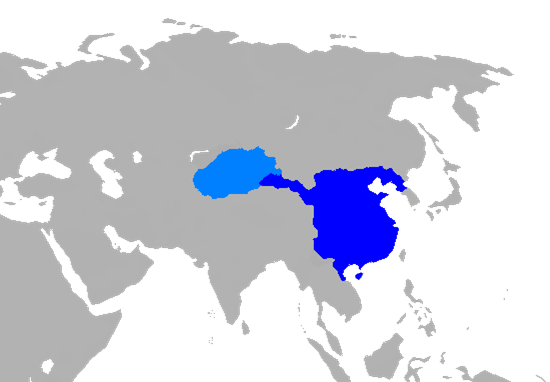
The Han dynasty ruled China from 206 BCE to 220 CE, apart from an interruption in the first century CE. It built on the unification achieved by the Qin and developed a durable model of imperial government. Expansion, agricultural production, learned officials and long-distance exchange helped shape the empire. Han culture also left important legacies in writing, craftsmanship, historical scholarship and technology.
From Qin unification to Han rule
In 221 BCE, the Qin ruler defeated rival kingdoms and established a unified empire. His government promoted common standards, including measures and official writing. Heavy demands and political conflict contributed to the rapid collapse of the dynasty after the first emperor's death. Liu Bang emerged from the struggles that followed and founded the Han dynasty.
Han rulers preserved important elements of centralised government while adjusting their relations with regional rulers and local elites. The dynasty is usually divided into Western and Eastern Han, separated by Wang Mang's rule and the restoration of Han power. These names refer to the locations of their principal capitals, Chang'an and Luoyang.
Under Wudi, who ruled from 141 to 87 BCE, military campaigns and diplomacy extended imperial influence. Conflict with the Xiongnu and efforts to control routes toward Central Asia encouraged the development of frontier defences and garrisons. Walls were built and repaired in different periods; the famous surviving stone walls mostly belong to much later centuries.
The emperor and his officials
The emperor occupied the highest position in the political order and was associated with the title Son of Heaven. Government depended on officials who administered territories, collected taxes, organised labour and transmitted information. Written records enabled the court to manage a large population, although distance and local interests limited its control.
Confucius had lived centuries before the Han. Traditions associated with his teachings stressed moral conduct, respect within relationships and the responsibilities of rulers. Under the Han, study of Confucian texts became increasingly important for educated officials. Good government was presented as a matter of exemplary behaviour as well as authority.
Education and recommendations helped some men enter official service, but access was unequal. The mature competitive examination system of later imperial China should not be projected back unchanged into this period. Wealth, family connections and political patronage also mattered.
Farming, society and exchange
Most people depended on agriculture. Peasants produced food and supported the state through taxes and labour obligations. Artisans made tools, textiles, pottery and luxury objects, while merchants connected producers and markets. Moral writings sometimes ranked merchants below farmers, but this did not prevent some traders from becoming wealthy. Social ideals and actual economic power were not always the same.
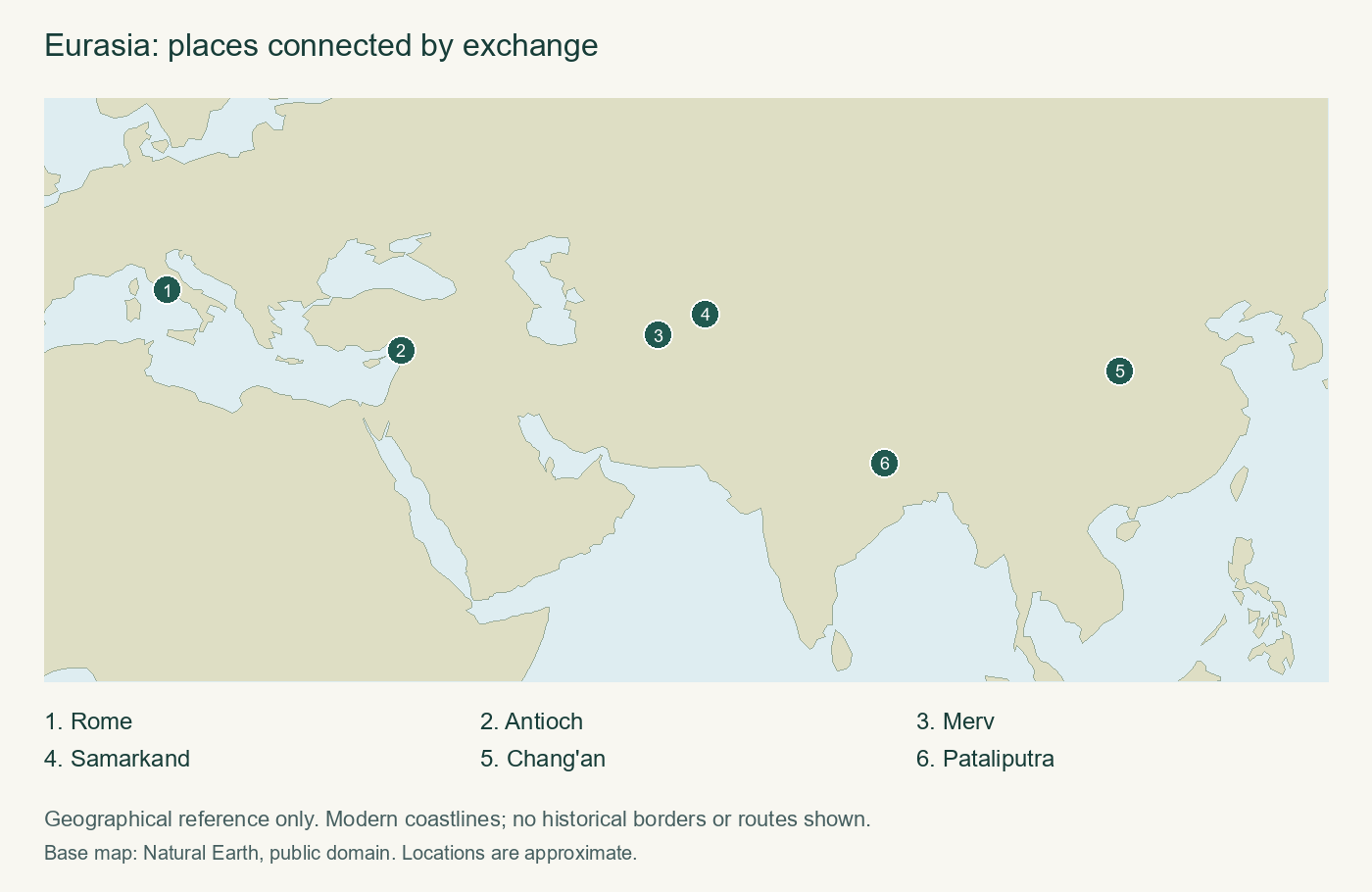
Han expansion and diplomatic contacts helped develop connections across Central Asia. Silk became one of the most valued products passing through these networks. Merchants generally travelled sections of the route, exchanging goods through intermediaries rather than making a single journey from China to Rome.
These connections also brought new ideas. Buddhism, originating in South Asia, began to establish a presence in China during the Han period. Its later growth involved translations, changing interpretations and support from different communities.
Knowledge, craftsmanship and the evidence of tombs
Han craftspeople worked with silk, lacquer, jade, clay and metals. The manufacture of paper developed during this period, with improvements traditionally associated with Cai Lun in 105 CE. Paper eventually offered an alternative to writing on materials such as bamboo strips and silk, though changes in use took time.
Astronomy, medicine and historical writing also attracted sustained attention. These fields combined observation with the intellectual and religious assumptions of their time. Their history is more complex than a list of inventions all attributed to one ruler or one century.
Tombs preserve figurines, household models and valuable objects intended to accompany the dead. They provide evidence of beliefs about the afterlife and of contemporary crafts and activities. Because rich burials survive with especially elaborate goods, they must be compared with other evidence before drawing conclusions about ordinary life. The Han state eventually fragmented, but many of its institutions and cultural traditions continued to shape later Chinese history.
Revision questions
Write an answer before opening the explanation. Your answers stay in this browser.
01 What did the Han inherit from the Qin, and how did their empire develop?
Read the explanation
Han rulers preserved important elements of centralised government while adjusting their relations with regional rulers and local elites. The dynasty is usually divided into Western and Eastern Han, separated by Wang Mang's rule and the restoration of Han power. These names refer to the locations of their principal capitals, Chang'an and Luoyang.
Under Wudi, who ruled from 141 to 87 BCE, military campaigns and diplomacy extended imperial influence. Conflict with the Xiongnu and efforts to control routes toward Central Asia encouraged the development of frontier defences and garrisons. Walls were built and repaired in different periods; the famous surviving stone walls mostly belong to much later centuries.
02 How did officials and Confucian learning contribute to government?
Read the explanation
Confucius had lived centuries before the Han. Traditions associated with his teachings stressed moral conduct, respect within relationships and the responsibilities of rulers. Under the Han, study of Confucian texts became increasingly important for educated officials. Good government was presented as a matter of exemplary behaviour as well as authority.
Education and recommendations helped some men enter official service, but access was unequal. The mature competitive examination system of later imperial China should not be projected back unchanged into this period. Wealth, family connections and political patronage also mattered.
03 How did agriculture and long-distance exchange support Han society?
Read the explanation
Han expansion and diplomatic contacts helped develop connections across Central Asia. Silk became one of the most valued products passing through these networks. Merchants generally travelled sections of the route, exchanging goods through intermediaries rather than making a single journey from China to Rome.
These connections also brought new ideas. Buddhism, originating in South Asia, began to establish a presence in China during the Han period. Its later growth involved translations, changing interpretations and support from different communities.
04 What can Han tombs and crafts reveal, and what are the limits of this evidence?
Read the explanation
Astronomy, medicine and historical writing also attracted sustained attention. These fields combined observation with the intellectual and religious assumptions of their time. Their history is more complex than a list of inventions all attributed to one ruler or one century.
Tombs preserve figurines, household models and valuable objects intended to accompany the dead. They provide evidence of beliefs about the afterlife and of contemporary crafts and activities. Because rich burials survive with especially elaborate goods, they must be compared with other evidence before drawing conclusions about ordinary life. The Han state eventually fragmented, but many of its institutions and cultural traditions continued to shape later Chinese history.