Between the first and fourth centuries CE, Christianity grew from a small religious movement into a major institution of the Roman Empire. This transformation depended on missionary activity, urban networks, community organisation and, eventually, imperial support. It was neither inevitable nor peaceful throughout. Relations between Christians and Roman authorities changed as both the religion and the empire developed.
Evidence for the early Christian world
The earliest Christian writings include Paul's letters, composed for communities facing questions about worship, behaviour and belonging. The Gospels offer accounts of Jesus' life, death and resurrection that express the faith of their authors. They were written after the events they describe, and historians compare their purposes, language and differences instead of assuming that all four are direct eyewitness reports.
Non-Christian authors provide other perspectives. Roman officials were often interested less in Christian theology than in the consequences of refusing established religious practices. Archaeology adds evidence from inscriptions, buildings, burials and objects. No single type of source gives a complete picture: religious texts illuminate beliefs, while administrative correspondence may reveal how a particular governor handled accusations.
Missionaries and Mediterranean networks
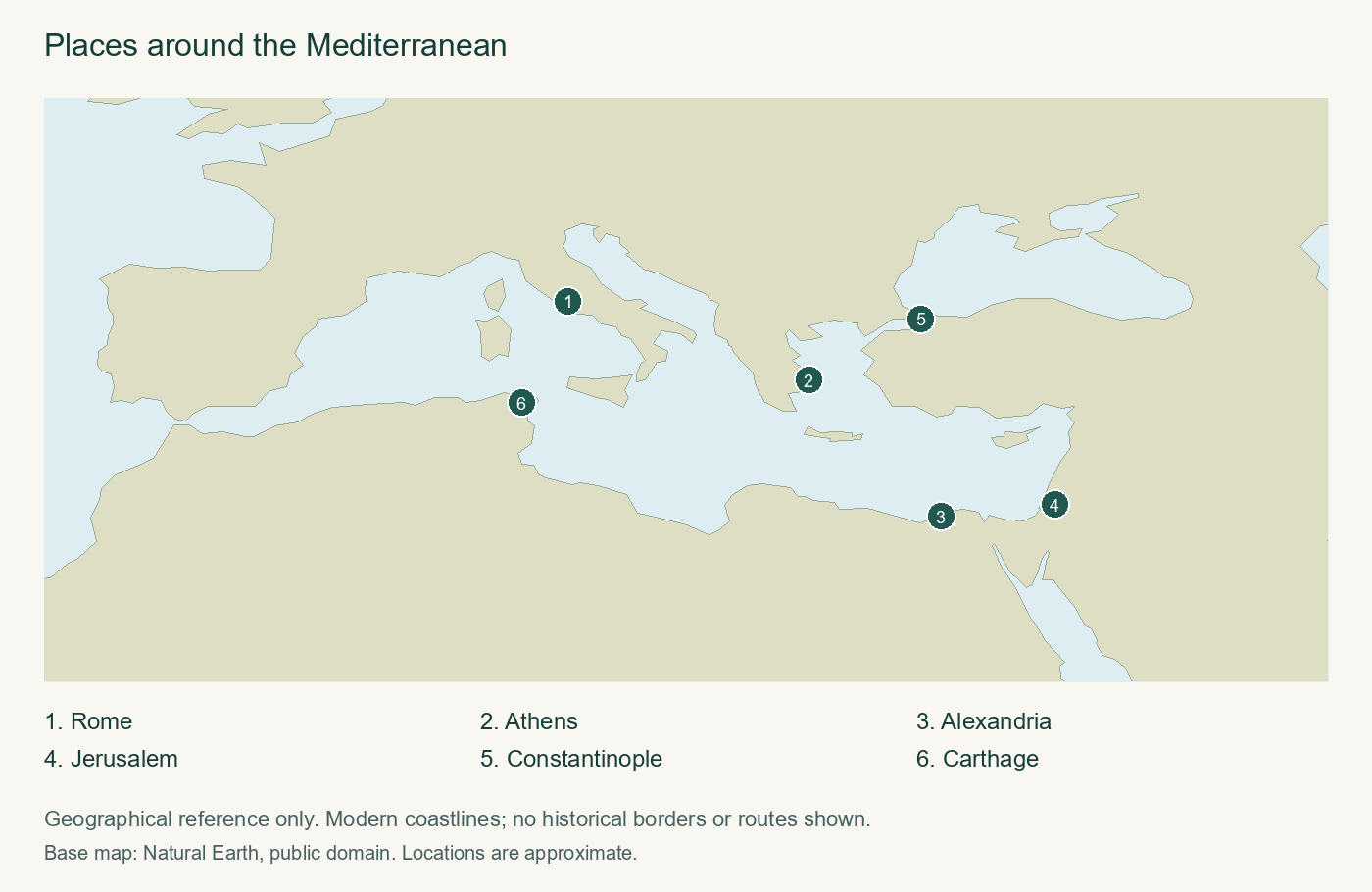
Paul's missions connected cities such as Corinth and Ephesus with a wider Christian movement. The inclusion of non-Jews widened the potential membership of the new religion. Communities communicated through letters, visits and travelling teachers, developing shared practices despite differences in local conditions.
The Roman Empire made travel possible across a large connected territory, although journeys remained expensive and dangerous. Greek served as a common language in many eastern cities. Ports, roads and commercial contacts helped ideas circulate. Christianity spread through personal relationships as well as public preaching, and its membership eventually included people of different social positions.
Care for the poor, support for widows and a strong sense of belonging could make communities attractive. These features should not be treated as a single explanation for conversion: individuals joined for varied spiritual, social and personal reasons. Growth also brought disputes over leadership, acceptable behaviour and the interpretation of Jesus' teachings.
Why Christians sometimes faced persecution
Roman religion was closely connected with civic life. Sacrifices honoured the gods and expressed loyalty to the community and its rulers. Christians who refused them could appear disobedient even if they otherwise respected imperial authority. Their unfamiliar meetings and exclusive religious claims could also provoke rumours or hostility.
A letter written by Pliny the Younger to Emperor Trajan around 112 shows the uncertainty of officials. Pliny questioned accused Christians and used sacrifices as a test of whether they had abandoned the faith. Trajan instructed him not to seek Christians out, while allowing punishment in certain circumstances. This exchange illustrates a particular policy, not an unchanging empire-wide campaign.
Persecution became more extensive at some later moments, especially during the third century and the early fourth. The Great Persecution under Diocletian and his colleagues began in 303. Christians who died rather than renounce their faith were remembered as martyrs. Their stories strengthened community identity, but their prominence in Christian memory should not obscure long periods and many places where believers lived without systematic persecution.
Constantine and the change in imperial policy
Constantine's victory at the Milvian Bridge in 312 became associated with Christian symbols and accounts of divine assistance. In 313, he and Licinius agreed to toleration and the restoration of confiscated Christian property. This did not immediately make Christianity the empire's only legal religion.
Constantine granted support to churches and clergy and sponsored major buildings. His involvement also reflected political concerns: religious division could threaten the unity of the empire. He called the Council of Nicaea in 325, where bishops debated the relationship between God the Father and the Son and agreed on a statement of belief. Disputes continued after the council, showing that imperial backing did not create instant agreement.
Constantine was baptised near the end of his life in 337. His reign marked a decisive change in the relationship between Church and state, but the Christianisation of society remained a long process involving later rulers and local communities.
An organised Church within a changing empire
Bishops increasingly exercised influence in towns, supervising worship, property and assistance to the needy. Important cities such as Rome, Alexandria, Antioch and Constantinople became centres of authority. The bishop of Rome acquired particular prestige, but the organisation of the fourth-century Church should not simply be equated with the later medieval papacy.
In 380, Theodosius I and his fellow emperors endorsed Nicene Christianity. Subsequent legislation restricted traditional sacrifices and temples. Imperial support thus altered the balance of power between religious groups, while Christians continued to disagree among themselves about doctrine.
When western imperial government broke down in the fifth century, churches and bishops remained important local institutions. In the eastern empire, centred on Constantinople, Christian emperors continued to rule for centuries. Christianity therefore both changed Roman society and inherited many of its urban networks, forms of organisation and cultural traditions.
Revision questions
Write an answer before opening the explanation. Your answers stay in this browser.
01 Why is it useful to compare Christian texts with other kinds of evidence?
Read the explanation
Non-Christian authors provide other perspectives. Roman officials were often interested less in Christian theology than in the consequences of refusing established religious practices. Archaeology adds evidence from inscriptions, buildings, burials and objects. No single type of source gives a complete picture: religious texts illuminate beliefs, while administrative correspondence may reveal how a particular governor handled accusations.
02 Why did persecution occur, and why should it not be described as continuous?
Read the explanation
A letter written by Pliny the Younger to Emperor Trajan around 112 shows the uncertainty of officials. Pliny questioned accused Christians and used sacrifices as a test of whether they had abandoned the faith. Trajan instructed him not to seek Christians out, while allowing punishment in certain circumstances. This exchange illustrates a particular policy, not an unchanging empire-wide campaign.
Persecution became more extensive at some later moments, especially during the third century and the early fourth. The Great Persecution under Diocletian and his colleagues began in 303. Christians who died rather than renounce their faith were remembered as martyrs. Their stories strengthened community identity, but their prominence in Christian memory should not obscure long periods and many places where believers lived without systematic persecution.
03 How did Constantine change the position of the Church without ending religious disputes?
Read the explanation
Constantine granted support to churches and clergy and sponsored major buildings. His involvement also reflected political concerns: religious division could threaten the unity of the empire. He called the Council of Nicaea in 325, where bishops debated the relationship between God the Father and the Son and agreed on a statement of belief. Disputes continued after the council, showing that imperial backing did not create instant agreement.
Constantine was baptised near the end of his life in 337. His reign marked a decisive change in the relationship between Church and state, but the Christianisation of society remained a long process involving later rulers and local communities.
04 How did church organisation connect the Roman world with later societies?
Read the explanation
In 380, Theodosius I and his fellow emperors endorsed Nicene Christianity. Subsequent legislation restricted traditional sacrifices and temples. Imperial support thus altered the balance of power between religious groups, while Christians continued to disagree among themselves about doctrine.
When western imperial government broke down in the fifth century, churches and bishops remained important local institutions. In the eastern empire, centred on Constantinople, Christian emperors continued to rule for centuries. Christianity therefore both changed Roman society and inherited many of its urban networks, forms of organisation and cultural traditions.