The Treaty of Versailles placed serious political and economic pressures on Germany's new republic. Between 1919 and 1923, resentment over the peace settlement interacted with wartime debt, anti-democratic violence and government decisions. The occupation of the Ruhr and hyperinflation brought these pressures together in 1923. Versailles was an important cause of instability, but it does not explain the entire crisis on its own.
A republic born from defeat
Germany's monarchy collapsed in November 1918 as military defeat and revolution undermined the old order. The new democratic state became known as the Weimar Republic, after the town where its constitution was prepared. Friedrich Ebert, a Social Democrat, became its first president. The elected Reichstag formed a central part of the new political system.
The republic inherited shortages, war debts and bitter divisions. Many conservatives associated it with surrender, while revolutionary groups opposed its parliamentary structure. Politicians who accepted the armistice and treaty became targets for nationalist accusations. The so-called stab-in-the-back myth falsely claimed that civilians had betrayed an undefeated army, although Germany's military leadership had itself sought an armistice.
Why Versailles provoked resentment
Germany received the draft terms on 7 May 1919 and signed on 28 June under severe pressure. The delegation could object in writing but could not negotiate as an equal. The term Diktat expressed anger at this unequal process as well as at the treaty's contents.
Territorial losses, military restrictions and exclusion from the League of Nations damaged national pride. Article 231 established the responsibility of Germany and its allies for wartime loss and damage. Many Germans interpreted it as a humiliating accusation that Germany alone had caused the war. Its legal role in reparations and its political reception therefore need to be distinguished.
The treaty created reparations liability, but the figure of 132 billion gold marks was fixed in 1921. Likewise, the Ruhr occupation and hyperinflation were later developments rather than clauses written into the 1919 treaty. Keeping these stages separate makes it possible to explain causation instead of treating everything as one event.
Political violence and the enemies of democracy
In March 1920, Wolfgang Kapp and armed supporters attempted to overthrow the government. The Kapp Putsch was linked partly to resentment over the reduction and disbanding of armed units. Rebels occupied Berlin and the government fled, but a general strike helped bring the coup to an end. Versailles contributed to the circumstances; anti-democratic loyalties and the existence of armed paramilitary groups also mattered.
Foreign Minister Walther Rathenau was murdered by right-wing extremists in June 1922. His Jewish identity, support for the republic and willingness to meet international obligations made him a target. His assassination demonstrates why antisemitism and organised political violence cannot be reduced to economic hardship or treaty resentment alone.
The republic survived these attacks, but they weakened confidence and made compromise dangerous. Nationalists could portray cooperation with the Allies as betrayal, even when the government judged it necessary to secure recovery.
Reparations and the occupation of the Ruhr
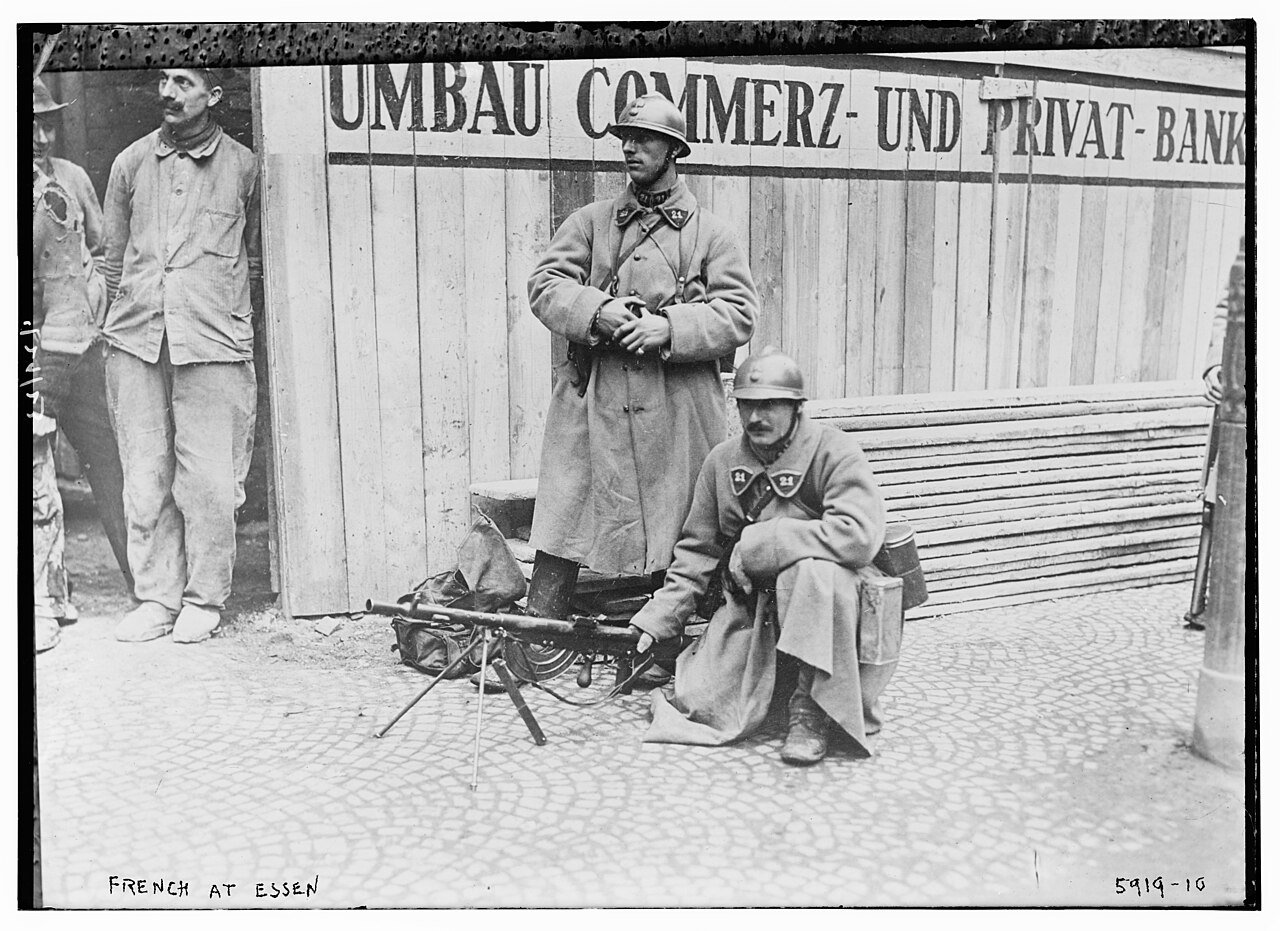
Disputes over Germany's capacity and willingness to pay intensified after the reparations settlement of 1921. Obligations involved deliveries of goods as well as money. Following defaults in required deliveries, French and Belgian troops entered the Ruhr on 11 January 1923. Britain did not join the occupation.
The Ruhr was a major industrial region containing coal mines, steelworks and transport networks. Occupation was intended to secure production directly, but the German government called for passive resistance. Workers and officials refused to cooperate, reducing output and disrupting the economy.
The state continued to support striking workers and affected businesses. It therefore faced falling tax receipts at the same time as rising expenditure. This combination intensified a financial crisis that already had deep roots.
How inflation became hyperinflation
Germany had financed much of the First World War through borrowing, leaving large debts. Post-war spending pressures, political uncertainty and an expanding money supply weakened the mark before 1923. Reparations, denominated in obligations that could not simply be met by printing paper marks, added to the pressure on the economy and confidence.
During passive resistance, the government issued more money to cover its costs while production declined. Confidence in the currency collapsed and prices rose at extraordinary speed. By November 1923, roughly 4.2 trillion paper marks exchanged for one US dollar. Workers tried to spend wages immediately before their purchasing power fell further.
The effects were unequal. Cash savings and fixed incomes could become almost worthless, damaging savers and pensioners. Some borrowers benefited because debts could be repaid in devalued currency. Property, goods or foreign currency often preserved value better. Hyperinflation therefore redistributed losses and advantages rather than making every person poorer in exactly the same way.
Stabilisation and historical judgement
Gustav Stresemann became chancellor in August 1923. His government ended passive resistance in September, reducing the burden of financing it. In November, the Rentenmark was introduced as part of measures to stabilise currency and public finance. Restoring confidence required changes in policy as well as the issue of a new note.
Political danger remained: Hitler's attempted coup in Munich in November showed that extremists hoped to exploit the crisis. Nevertheless, the republic survived, and later agreements on reparations and foreign lending helped a period of recovery. Stabilisation did not restore the savings already destroyed or erase the memory of hardship.
Versailles weakened the republic's legitimacy and created obligations that contributed to the Ruhr confrontation. Yet wartime finance, extremist ideologies, the occupation itself and the decision to fund passive resistance explain why the crisis became so severe. The most convincing explanation connects these causes and distinguishes long-term weaknesses from immediate triggers and accelerators.
Revision questions
Write an answer before opening the explanation. Your answers stay in this browser.
01 Why did Germans resent Versailles, and which later events must be distinguished from its clauses?
Read the explanation
Territorial losses, military restrictions and exclusion from the League of Nations damaged national pride. Article 231 established the responsibility of Germany and its allies for wartime loss and damage. Many Germans interpreted it as a humiliating accusation that Germany alone had caused the war. Its legal role in reparations and its political reception therefore need to be distinguished.
The treaty created reparations liability, but the figure of 132 billion gold marks was fixed in 1921. Likewise, the Ruhr occupation and hyperinflation were later developments rather than clauses written into the 1919 treaty. Keeping these stages separate makes it possible to explain causation instead of treating everything as one event.
02 How did the Ruhr occupation and passive resistance worsen the government's finances?
Read the explanation
The Ruhr was a major industrial region containing coal mines, steelworks and transport networks. Occupation was intended to secure production directly, but the German government called for passive resistance. Workers and officials refused to cooperate, reducing output and disrupting the economy.
The state continued to support striking workers and affected businesses. It therefore faced falling tax receipts at the same time as rising expenditure. This combination intensified a financial crisis that already had deep roots.
03 Explain how inflation became hyperinflation and why its effects were unequal.
Read the explanation
During passive resistance, the government issued more money to cover its costs while production declined. Confidence in the currency collapsed and prices rose at extraordinary speed. By November 1923, roughly 4.2 trillion paper marks exchanged for one US dollar. Workers tried to spend wages immediately before their purchasing power fell further.
The effects were unequal. Cash savings and fixed incomes could become almost worthless, damaging savers and pensioners. Some borrowers benefited because debts could be repaid in devalued currency. Property, goods or foreign currency often preserved value better. Hyperinflation therefore redistributed losses and advantages rather than making every person poorer in exactly the same way.
04 How far does Versailles explain Germany's crisis by the end of 1923?
Read the explanation
Political danger remained: Hitler's attempted coup in Munich in November showed that extremists hoped to exploit the crisis. Nevertheless, the republic survived, and later agreements on reparations and foreign lending helped a period of recovery. Stabilisation did not restore the savings already destroyed or erase the memory of hardship.
Versailles weakened the republic's legitimacy and created obligations that contributed to the Ruhr confrontation. Yet wartime finance, extremist ideologies, the occupation itself and the decision to fund passive resistance explain why the crisis became so severe. The most convincing explanation connects these causes and distinguishes long-term weaknesses from immediate triggers and accelerators.