A historical presentation explains a question through an organised argument supported by evidence. Its purpose is not to recite everything known about a topic, but to help an audience understand what happened, why it happened and how historians know. A clear structure makes detailed content easier to follow without sacrificing accuracy.
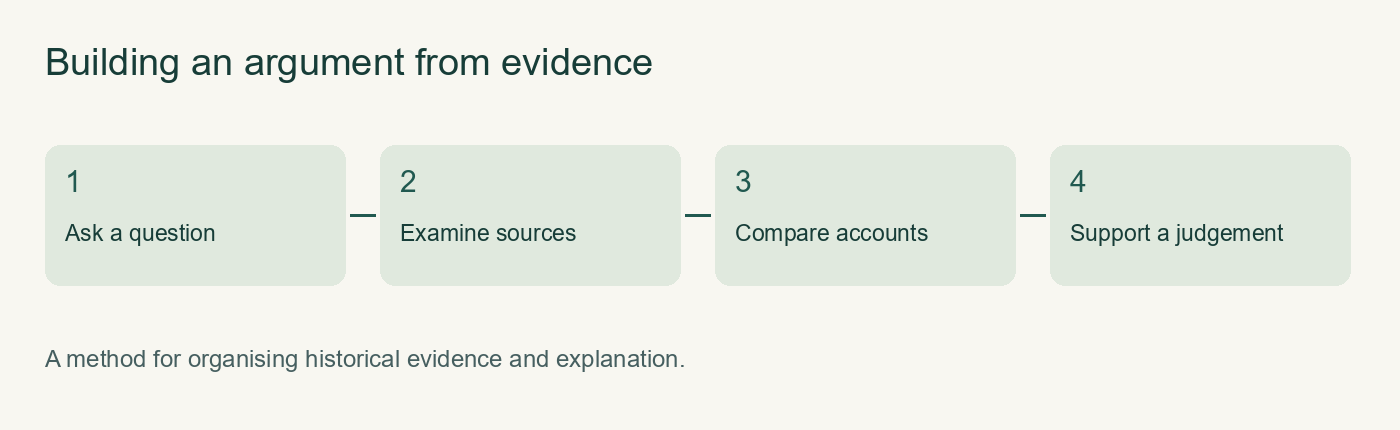
A question gives the presentation direction
A topic names an area of study; a question identifies a problem to explain. “Ancient writing” is a topic, whereas “How did writing change the government of early states?” establishes a direction. The question helps determine which information belongs in the presentation and which material is interesting but unnecessary.
An introduction gives the essential context: period, place, people and key vocabulary. It then states the question and indicates the main stages of the explanation. A striking object, image or fact can attract attention, provided it introduces the argument rather than distracting from it. Listeners need enough context to understand the evidence that follows.
Organising the main explanation
A chronological structure follows change over time and works well when the order of events explains a development. A causal structure examines reasons, events and consequences. A thematic structure separates related dimensions, such as politics, economics and society. These approaches can be combined, but every main section should have a clear purpose.
Within a section, a useful pattern connects a point, evidence and explanation. For example, an argument that writing strengthened administration can be supported by records of grain deliveries or labour. The explanation then shows how those records allowed officials to monitor resources beyond personal memory. Evidence becomes persuasive when its relevance is explained.
Dates, names and places should be precise, but precision is not the same as including every detail. A few well-chosen examples can support an argument more effectively than a long catalogue. Transitions explain how one section leads to another and help an audience that cannot reread a spoken sentence.
Using sources and visual evidence
Historical evidence needs identification and context. An inscription, painting or political speech was made by someone, at a particular time, for an audience and purpose. Explaining these features helps distinguish what a source shows from what it cannot establish. A ruler's boast, for example, is evidence of royal self-presentation even when it exaggerates achievements.
Maps locate events and relationships; photographs and artefacts support observations; a simple diagram can clarify a process. Each visual should have a readable caption and a source. If projected pages are used, they should guide the listener with limited text while the speaker supplies the explanation. Copying a paragraph onto a screen and reading it aloud divides attention without adding understanding.
References should make borrowed information and images traceable. Direct quotations need clear attribution and exact wording. Paraphrasing means expressing a source's idea accurately in new language, not removing its attribution. Uncertainty should be stated when the evidence does not support a firm conclusion.
Concluding and delivering the argument
The conclusion answers the original question using the main findings. It can weigh the relative importance of causes, explain the most significant change or identify a limit in the evidence. It should not introduce an entirely new argument that the audience has no time to assess.
Preparation includes rehearsing aloud and checking the time. Most of the presentation should be devoted to the explanation, with enough room for context at the beginning and a reasoned answer at the end. Brief speaking notes, deliberate pauses and clear definitions help listeners follow complex material. Questions from the audience then provide an opportunity to clarify the reasoning and acknowledge where further evidence would be needed.
Revision questions
Write an answer before opening the explanation. Your answers stay in this browser.
01 How does a historical question help select and organise content?
Read the explanation
An introduction gives the essential context: period, place, people and key vocabulary. It then states the question and indicates the main stages of the explanation. A striking object, image or fact can attract attention, provided it introduces the argument rather than distracting from it. Listeners need enough context to understand the evidence that follows.
02 Explain how a point, evidence and explanation work together.
Read the explanation
Within a section, a useful pattern connects a point, evidence and explanation. For example, an argument that writing strengthened administration can be supported by records of grain deliveries or labour. The explanation then shows how those records allowed officials to monitor resources beyond personal memory. Evidence becomes persuasive when its relevance is explained.
Dates, names and places should be precise, but precision is not the same as including every detail. A few well-chosen examples can support an argument more effectively than a long catalogue. Transitions explain how one section leads to another and help an audience that cannot reread a spoken sentence.
03 What makes the use of a source or image historically convincing?
Read the explanation
Maps locate events and relationships; photographs and artefacts support observations; a simple diagram can clarify a process. Each visual should have a readable caption and a source. If projected pages are used, they should guide the listener with limited text while the speaker supplies the explanation. Copying a paragraph onto a screen and reading it aloud divides attention without adding understanding.
References should make borrowed information and images traceable. Direct quotations need clear attribution and exact wording. Paraphrasing means expressing a source's idea accurately in new language, not removing its attribution. Uncertainty should be stated when the evidence does not support a firm conclusion.
04 What should a conclusion do, and how does rehearsal improve delivery?
Read the explanation
Preparation includes rehearsing aloud and checking the time. Most of the presentation should be devoted to the explanation, with enough room for context at the beginning and a reasoned answer at the end. Brief speaking notes, deliberate pauses and clear definitions help listeners follow complex material. Questions from the audience then provide an opportunity to clarify the reasoning and acknowledge where further evidence would be needed.