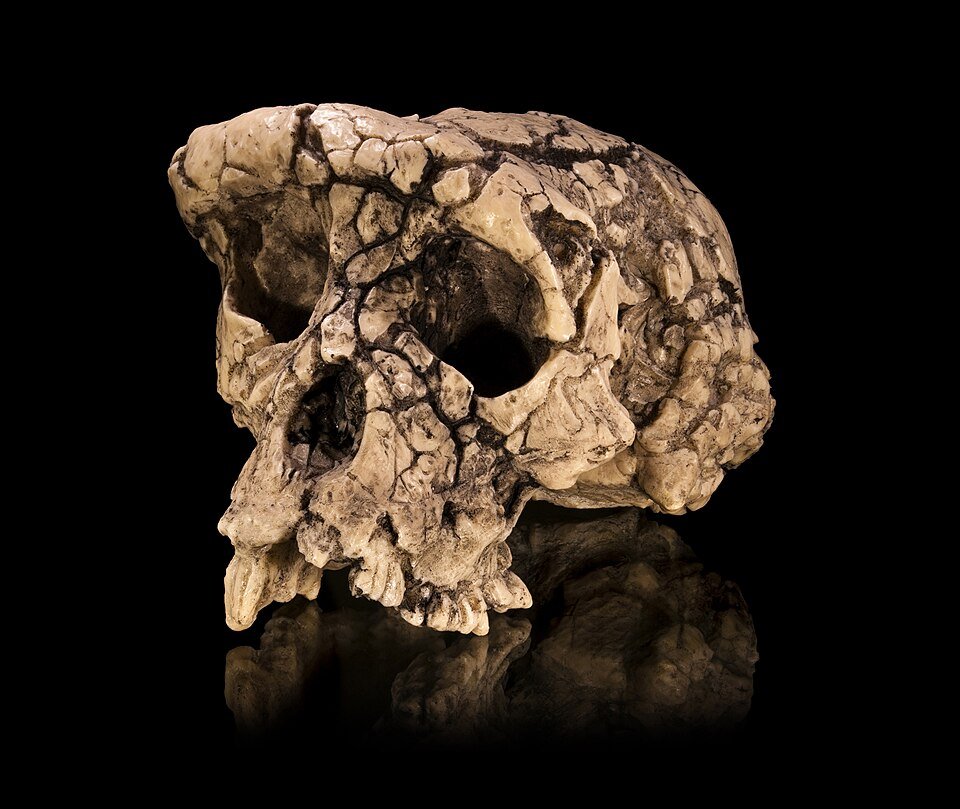
Key question. Where did humans come from, and how did our species come to live on every continent?
In this lesson
- how historians and scientists study the human past before writing;
- the evidence for the African origins of the human family;
- the different human species and the Old Stone Age;
- the “human revolution” of Homo sapiens in Africa and the power of collective learning;
- the world of the Ice Age and its land bridges;
- the great migrations into Eurasia, Australia, the Americas and the Pacific.
Human origins are studied through fossils, archaeological objects and genetic evidence. These sources show that the human family emerged in Africa and developed through a branching evolutionary history. Several related species existed at the same time; the process was not a simple ladder leading inevitably to modern humans. Today all living people belong to one species, Homo sapiens.
Hominins are the first forms of human life. Long before our own species existed, several of them lived side by side in Africa. Three dates frame the story: about 7 million years ago, the first hominins lived in Africa; about 300,000 years ago, our own species, Homo sapiens, appeared in Africa; today, Homo sapiens lives on every continent. Two common mistakes are worth avoiding. Humans did not “come from chimpanzees”: humans and chimpanzees share a common ancestor that lived about 7 to 6 million years ago. And no human ever saw a dinosaur: the large dinosaurs died out about 66 million years ago, almost 60 million years before Toumaï.