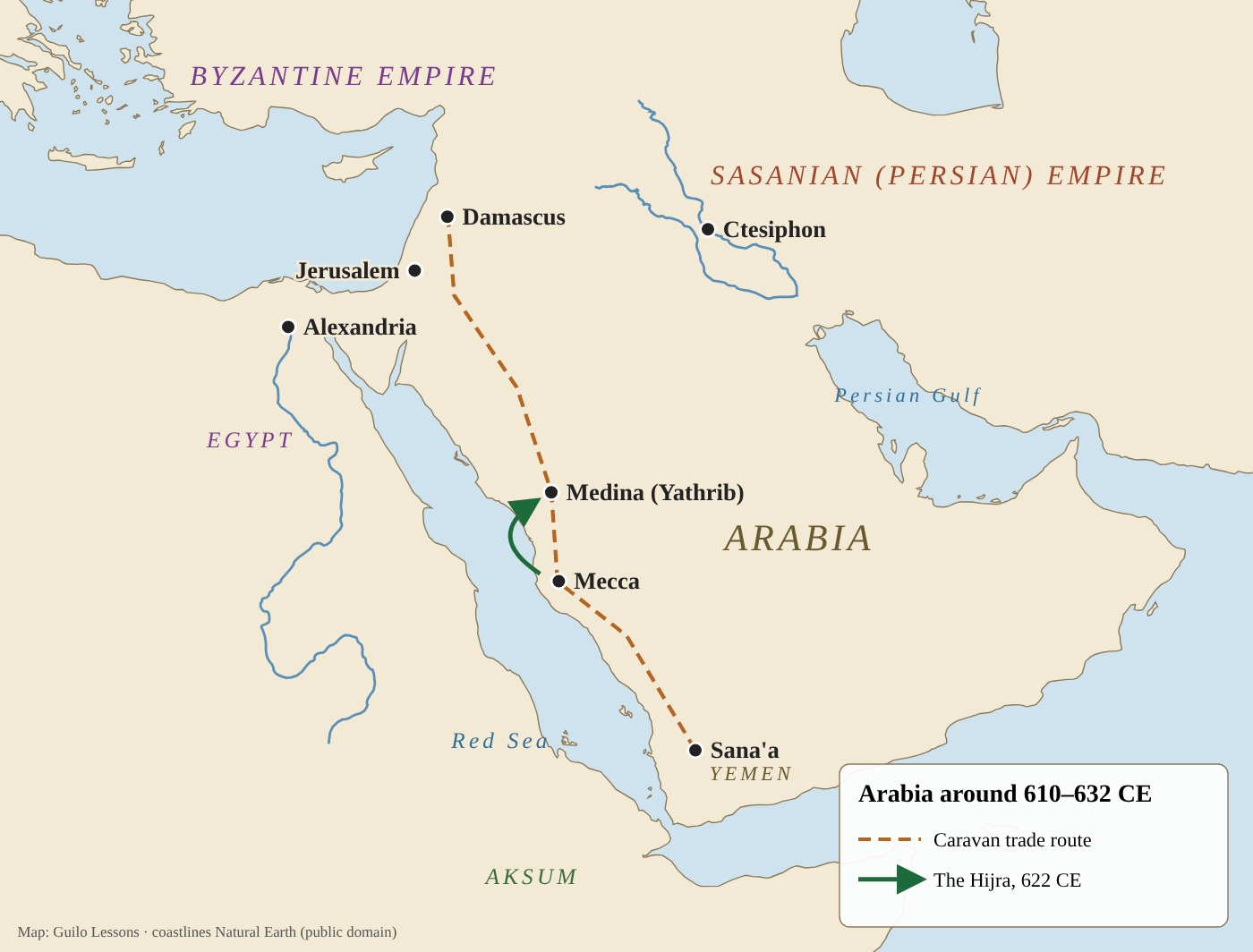
Key question. How did a new religion born in Arabia in the seventh century transform Arabian society so quickly?
In this lesson
- What Arabia was like before Islam, and why Mecca mattered.
- The life of the Prophet Muhammad and the message of the Quran.
- Why Mecca’s leaders turned against the first Muslims.
- The Five Pillars of Islam and the idea of the umma.
- How the move to Medina in 622 turned the faith into a state, and how Islam won over Arabia.
- How the beginnings of Islam differed from those of Christianity, and what the first Muslim community left to the world today.
Imagine a city in the middle of a desert, with no river and almost no farmland, yet rich and famous across a whole peninsula. Its wealth comes from trade caravans of hundreds of camels and from pilgrims who visit its shrine. In this city, around the year 610, a forty-year-old merchant begins to tell his neighbours that God has spoken to him. Within twenty-two years his message has united the warring tribes of Arabia. Within a century, his followers rule lands from Spain to India. Today almost one person in four on Earth is a Muslim, including most people in Malaysia. This lesson explains how it began.