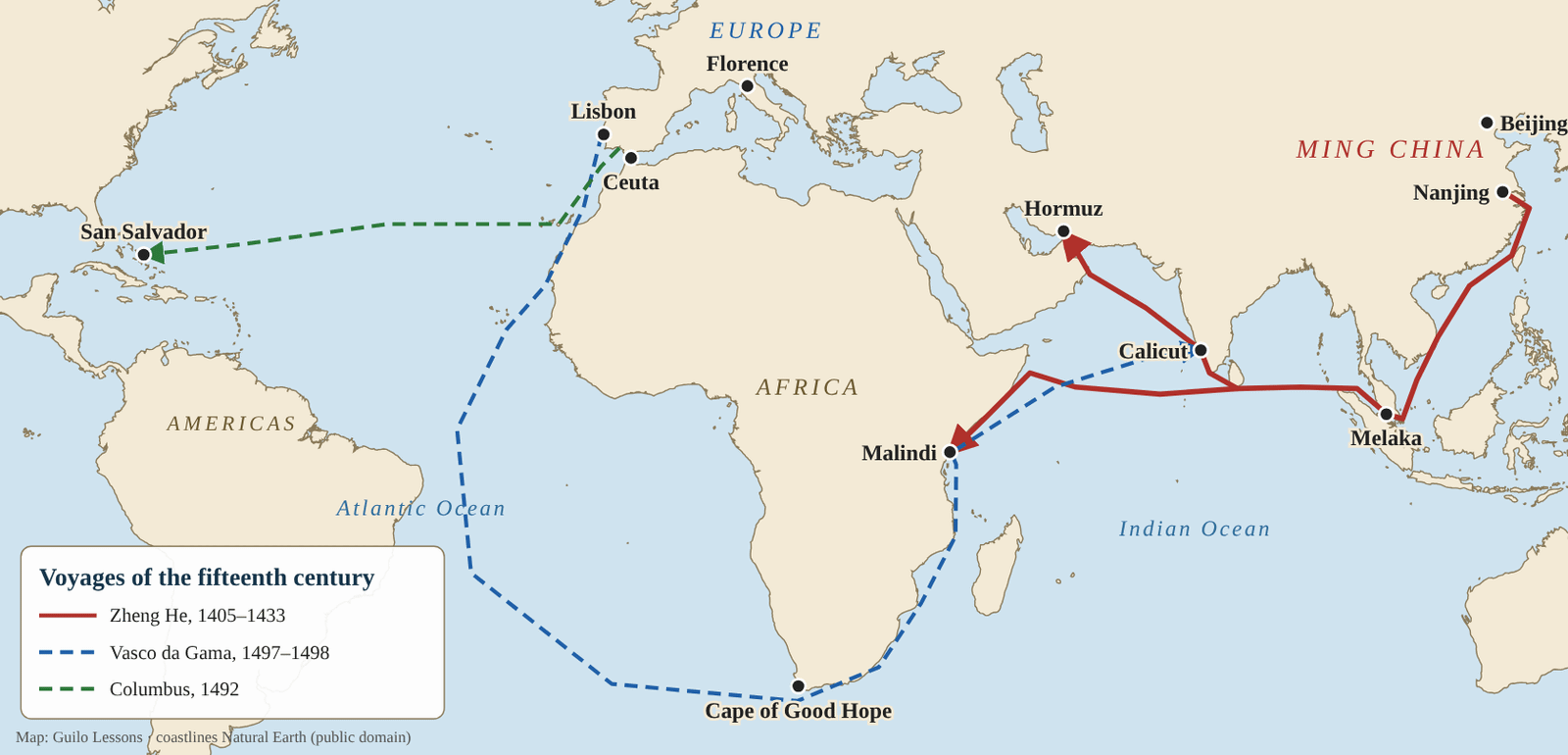
Key question. Why did Ming China stop its great ocean voyages while Europe’s much smaller voyages led to world power?
In this lesson
- How Ming China recovered after Mongol rule and the plague.
- What Zheng He’s voyages achieved, and why they ended in 1433.
- How Zheng He’s fleets linked China with Melaka.
- How Europe rebuilt itself through rival states, the Renaissance and printing.
- How the Portuguese, Columbus and da Gama opened new sea routes.
- Why Chinese and European expansion took such different paths.
In 1414, crowds in Beijing gathered to see a strange animal arrive at the emperor’s court: a giraffe, brought from Africa by way of Bengal on one of China’s great ships. Eighty-four years later, in 1498, three small Portuguese ships dropped anchor at Calicut in India, after sailing all the way around Africa. One of these voyages led nowhere; the other opened five centuries of European power in Asia. This lesson asks why.