Key question. Was the Treaty of Versailles fair? This lesson follows the whole story of the peace settlement with Germany: what the Big Three wanted and why none of them got everything, the terms of the treaty, how Germans reacted, what the treaty did to Germany up to the end of 1923, how it was judged at the time and since, and the other peace treaties of 1919–23.
This topic is taught in 4 lessons. Work through them in order.
- Part 1: The peacemakers and their aims (this lesson)
- Part 2: Peacemaking and the terms of the treaty
- Part 3: German reactions and the crisis of 1923
- Part 4: Was the treaty fair?
Focus points.
- What were the motives and aims of the Big Three at Versailles?
- Why did the victors not get everything they wanted?
- What was the impact of the Treaty on Germany up to the end of 1923?
- Could the Treaty be justified at the time?
Specified content covered here: the roles of Wilson, Clemenceau and Lloyd George in the peacemaking process; the terms of the Treaty; the social, economic and political impact of the Treaty in Germany to the end of 1923; contemporary opinions about the Treaty; the other peace treaties.
Making peace after a terrible war
However long or violent a war is, the two sides must eventually make peace. Because war is destructive and leaves bitterness behind, making peace after a long conflict can be the hardest job of all.
The peacemakers of 1919 had a particularly hard task. The First World War had involved more countries, used more powerful weapons and caused more deaths and physical destruction than any war before it. It had bankrupted some countries and led to revolutions in others, above all in Russia in 1917. Everywhere there was bitterness and resentment. Almost everyone agreed that the peacemakers' job was to prevent another war like it, but nobody agreed on how to do it.
A balancing act. Any treaty is a balancing act: the peacemakers must keep the victors happy, but the defeated country must also accept the terms. Was it really possible to produce a treaty that all sides would see as fair? That is the key question for this topic. To answer it you need to know what the peacemakers hoped to achieve, how they worked, what they decided and why. Then you can judge whether people at the time thought the treaty was fair, and whether historians, with hindsight, think it was.

Activity 1.1 · A first look at fairness
Study Source 1. (a) Does the German man think the treaty is fair? Why or why not? (b) Does the cartoonist think it is fair? Why or why not? (c) What is the message of the cartoon?
Show a model answer
(a) No. He calls the demands 'monstrous' and throws out his arms in outrage. (b) Yes. The caption makes him admit that Germany would have demanded four times as much if it had won, so the cartoonist thinks his complaint is hypocritical and the demands are reasonable. (c) German protests about the peace terms should not be taken seriously: Germany would have imposed an even harsher peace itself, as it had done on Russia at Brest-Litovsk in 1918.
How the war ended. In March 1918 Germany forced the new Bolshevik government of Russia to sign the Treaty of Brest-Litovsk, which took away between a quarter and a third of Russia's population and much of its best farmland and industry. Germany's great spring offensives in the West then failed, and in October 1918 the German government asked President Wilson for an armistice on the basis of his Fourteen Points, which German leaders had ignored while they still hoped to win. Revolution broke out in Germany, Kaiser Wilhelm II abdicated on 9 November 1918 and the armistice came into force on 11 November. German territory had not been invaded and the German army was still on foreign soil, so many Germans did not believe they had really been defeated.
Armistice: an end to the fighting; an agreement to stop fighting while peace terms are worked out.
Treaty of Brest-Litovsk: the treaty between Germany and Russia in March 1918 which ended the war between them. Germany took massive amounts of land and reparations from Russia.
High hopes for peace. Looking back, the peacemakers may seem to have had an impossible job, but that is not how people saw it at the time. There was great optimism, and one of the main reasons was the American President, Woodrow Wilson. When he arrived in Europe in December 1918 for the Paris Peace Conference, he was seen almost as a saint. Newspapers reported wounded soldiers in Italy trying to kiss the hem of his cloak, and peasant families in France kneeling to pray as his train went past.
Timeline: from the Franco-Prussian War to the last peace treaty
| Date | Event |
|---|---|
| 1870–71 | Franco-Prussian War. Prussia defeats France; the German Empire is proclaimed in the Hall of Mirrors at Versailles on 18 January 1871 and France loses Alsace-Lorraine. |
| August 1914 | Germany invades Belgium and France using the Schlieffen Plan (drawn up in 1905): the First World War begins in the West. |
| April 1917 | The USA enters the war. |
| November 1917 | Clemenceau becomes Prime Minister of France. |
| 8 January 1918 | Wilson presents the Fourteen Points to the US Congress. |
| 3 March 1918 | Treaty of Brest-Litovsk: Russia leaves the war and loses huge territories. |
| October 1918 | Germany asks Wilson for an armistice based on the Fourteen Points. |
| 9–11 November 1918 | The Kaiser abdicates; the armistice ends the fighting on 11 November. |
| December 1918 | Wilson arrives in France (13 December); Lloyd George's coalition wins the British general election (14 December). |
| 18 January 1919 | The Paris Peace Conference opens. |
| April 1919 | Orlando leaves Paris for a time in protest over Fiume; the Covenant of the League of Nations is adopted (28 April). |
| 7 May 1919 | The draft terms are handed to the German delegation. |
| 28 June 1919 | The Treaty of Versailles is signed in the Hall of Mirrors. |
| 10 September 1919 | Treaty of Saint-Germain with Austria. |
| 25 September – 2 October 1919 | Wilson collapses during a speaking tour and then suffers a serious stroke. |
| 19 November 1919 | The US Senate refuses to ratify the Treaty of Versailles. |
| 27 November 1919 | Treaty of Neuilly with Bulgaria. |
| 10 January 1920 | The Treaty of Versailles comes into force and the League of Nations is founded. |
| 19 March 1920 | Second Senate vote: the treaty again fails to win a two-thirds majority. |
| 4 June 1920 | Treaty of Trianon with Hungary. |
| 10 August 1920 | Treaty of Sèvres with the Ottoman Empire (Turkey). |
| 24 July 1923 | Treaty of Lausanne replaces Sèvres. |
Wilson's aims
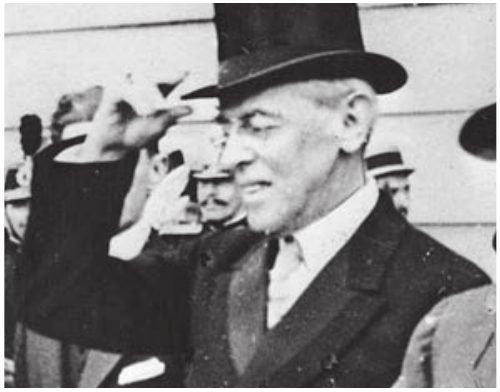
Profile: Woodrow Wilson, President of the USA.
- Background: born in 1856. He was a university professor (and later president of Princeton University) before he entered politics in 1910 as Governor of New Jersey. He was elected President in 1912 (taking office in March 1913) and re-elected in 1916.
- From 1914 to 1917 he concentrated on keeping the USA out of the war. Once the USA had joined the war in April 1917, he drew up the Fourteen Points as the basis for ending the war fairly, so that future wars could be avoided.
- Character: an idealist and a reformer. As President he had campaigned against corruption in politics and business. However, his record on the rights of African Americans was poor: his government extended racial segregation in federal offices.
- He was obstinate: once he had made up his mind on an issue, he was almost impossible to shift.
Idealist: a person motivated by particular beliefs, for example a commitment to the right of peoples to rule themselves.
In January 1918 Wilson made a speech setting out his Fourteen Points: guidelines for a just and lasting peace treaty to end the conflict.
Fourteen Points: the fourteen principles for a just and lasting peace that President Wilson announced to the US Congress on 8 January 1918.
Wilson's ideas. How did Wilson think the peacemakers could build a better and more peaceful world?
- Do not be too harsh on Germany. Wilson did believe Germany should be punished. But he also believed that if Germany was treated harshly, it would one day recover and want revenge. He was also worried that extremist groups, especially communists, might exploit German resentment and even seize power in Germany, as they had in Russia in 1917.
- Strengthen democracy in the defeated countries. For Wilson democracy was a key to peace in Europe. If leaders in the defeated nations had to listen to the views of their people and win their votes, the people would not let their leaders cause another war.
- Give self-determination to small nations that had once been part of the European empires. He wanted the different peoples of eastern Europe (for example Poles, Czechs and Slovaks) to rule themselves rather than be part of Austria-Hungary's empire.
- International co-operation. Nations should co-operate to achieve world peace through a League of Nations, the most important of the Fourteen Points in Wilson's eyes. He insisted that the Covenant (the founding rules) of the League should be written into each of the peace treaties.
Democracy: a political system in which the population votes for its government in elections held on a regular basis.
Self-determination: the right of a people (a national group) to decide for itself how and by whom it is governed, rather than being ruled by an empire or another nation.
Co-operation: working together; it could be political, economic or legal.
League of Nations: an organisation set up to manage international disputes and prevent wars after the First World War. It was the brainchild of US President Woodrow Wilson.
An idealist, but not a pushover. These principles show that Wilson was an idealist. But he was not a politician who could be pushed around. For example, he refused to cancel the war debts that Britain and its allies owed to the USA, so that he could put pressure on them to accept his ideas.
There were limits to both his principles and his power. Ethnic groups were mixed together, strategic interests competed with national claims, and the European empires resisted any idea of self-determination for their colonies. At home, Wilson also needed the Senate's consent to ratify a treaty, which in the end he failed to obtain.

In Source 2 Wilson is the cook, in a hat marked 'America', pouring a bottle labelled 'Sweet Oil of Brotherhood' into a huge cauldron marked 'Peace Soup' that is already crammed with weapons. Around the pot stand cooks representing Italy, England, France and Australia, each carrying a bucket of 'National Sentiment' to add to the mixture.
Activity 1.2 · Analysing 'The Melting Pot'
Study Source 2. Who is making the soup? Who is helping him? What are they adding to the mix? What is already in the pot? What is the cartoonist's message?
Show a model answer
Wilson (America) is making the soup and the other victorious nations (Italy, England, France, Australia) are helping him. He adds 'sweet oil of brotherhood', his idealism; they add buckets of 'national sentiment', their own national interests. The pot is already full of weapons, the bitterness and militarism left by the war. The message is that Wilson's idealistic peace is being mixed with, and probably spoilt by, the selfish national interests of the other victors, so the 'peace soup' is unlikely to turn out as he hoped.
The Fourteen Points
Wilson announced the Fourteen Points in a speech to the US Congress on 8 January 1918, ten months before the war ended. Points 1 to 5 set out general principles, points 6 to 13 deal with particular territories, and point 14 proposes the League of Nations.
| Point | What it proposed |
|---|---|
| 1 | No secret treaties: peace agreements should be made openly and diplomacy carried out in public view. |
| 2 | Freedom of navigation on the seas, outside territorial waters, in peace and in war. |
| 3 | Removal, as far as possible, of economic barriers, so that trade between nations would be free. |
| 4 | All countries to reduce their armaments to the lowest level consistent with domestic safety (disarmament). |
| 5 | Colonial claims to be settled impartially, with the interests of colonial peoples weighed equally with the claims of the colonial powers: colonies to have a say in their own future. |
| 6 | German and other foreign troops to leave Russian territory; Russia to be free to choose its own political future. |
| 7 | Belgium to be evacuated and its independence restored. |
| 8 | Invaded French territory to be freed and restored, and Alsace-Lorraine returned to France. |
| 9 | Italy's frontier with Austria to be readjusted along clearly recognisable lines of nationality. |
| 10 | The peoples of Austria-Hungary to be given the opportunity of autonomous development (self-determination for the peoples of eastern Europe). |
| 11 | Romania, Serbia and Montenegro to be evacuated and restored; Serbia to have access to the sea; Balkan borders to follow nationality. |
| 12 | The Turkish parts of the Ottoman Empire to remain sovereign; the other peoples of the Turkish empire to have self-determination; the Dardanelles to be open to all ships. |
| 13 | An independent Polish state to be created, with secure access to the sea. |
| 14 | A general association of nations (the League of Nations) to be set up to guarantee the independence and borders of large and small states alike. |
Secret treaties: agreements between states that are kept hidden from the public and from other countries, such as the 1915 Treaty of London which promised Italy land if it joined the Allies. Wilson blamed such treaties for helping to cause the war.
Free trade: trade between countries without tariffs (import taxes) or other barriers.
Disarmament: the process of scrapping land, sea or air weapons.
The first and last points, in Wilson's own words, show the new kind of diplomacy he wanted.
“Open covenants of peace, openly arrived at, after which there shall be no private international understandings of any kind but diplomacy shall proceed always frankly and in the public view.”
Woodrow Wilson, Point 1 of the Fourteen Points, speech to Congress, 8 January 1918
“A general association of nations must be formed under specific covenants for the purpose of affording mutual guarantees of political independence and territorial integrity to great and small states alike.”
Woodrow Wilson, Point 14 of the Fourteen Points, speech to Congress, 8 January 1918
Exam tip: you do not need to learn all fourteen points. Know the main ideas well (no secret treaties, freedom of the seas, free trade, disarmament, self-determination, the League of Nations) and be ready to explain which of them worried Britain and France.
The Paris Peace Conference, 1919–20
Factfile.
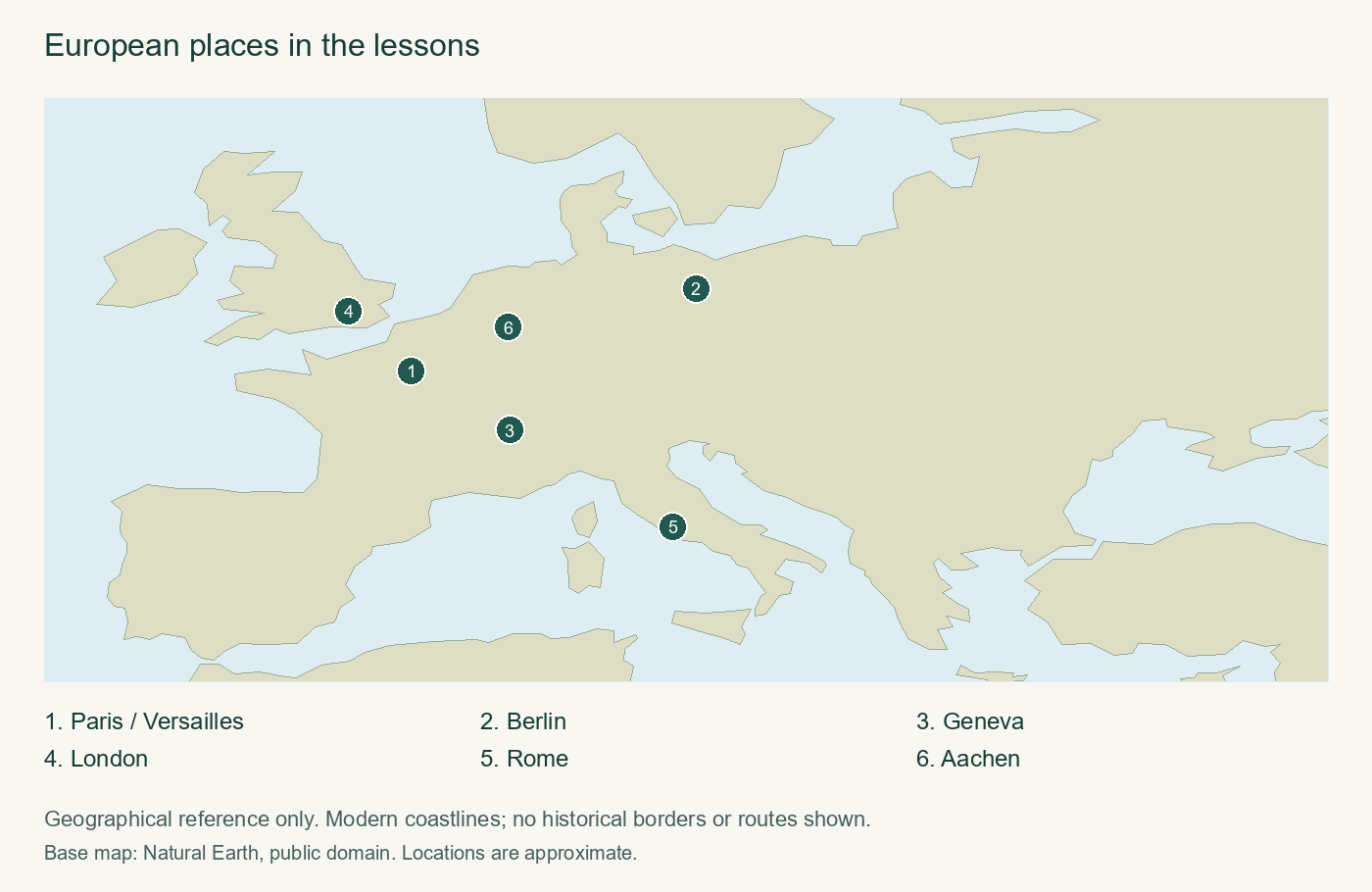
- The conference met in Paris, mainly at the French Foreign Ministry on the Quai d'Orsay. Only the signing of the treaty with Germany took place in the Palace of Versailles, a short distance from the city.
- It lasted about twelve months, from January 1919 to January 1920.
- Thirty-two nations were supposed to be represented, but no one from the defeated countries was invited to take part in the negotiations. Bolshevik Russia was not invited either.
- Five treaties were drawn up. The main one was the Treaty of Versailles, which dealt with Germany. The other treaties dealt with Germany's allies.
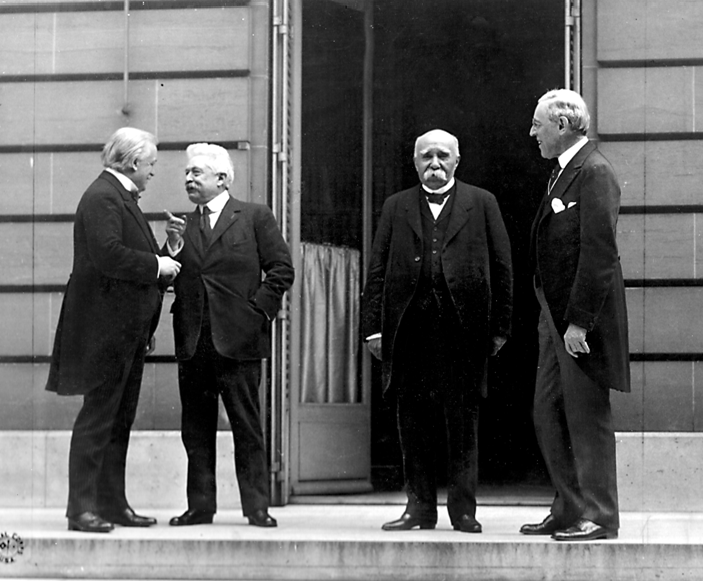
- All the important decisions on the fate of Germany were taken by Clemenceau (Prime Minister of France), Lloyd George (Prime Minister of Britain) and Wilson (President of the USA), who together were known as the Big Three.
- The Big Three were supported by a huge army of diplomats and expert advisers, but they often ignored their advice.
Paris Peace Conference: the conference of the victorious powers, opened in Paris on 18 January 1919, which decided how to officially end the First World War. It drew up the Treaty of Versailles with Germany and the treaties with Germany's allies.
Big Three: the three main leaders at the Versailles peace conference in 1919: Lloyd George (Britain), Wilson (USA) and Clemenceau (France). With Italy's Orlando they formed the Big Four.
| Treaty | Defeated country | Date signed |
|---|---|---|
| Versailles | Germany | 28 June 1919 |
| Saint-Germain | Austria | 10 September 1919 |
| Neuilly | Bulgaria | 27 November 1919 |
| Trianon | Hungary | 4 June 1920 |
| Sèvres (later replaced by Lausanne, 1923) | Ottoman Empire (Turkey) | 10 August 1920 |
Did everyone share Wilson's viewpoint?
Not surprisingly, when Wilson talked about a lasting peace and justice, the other leaders agreed with him. After all, who would stand up in public and say they were against a just and lasting peace?
However, many doubted Wilson's ideas for achieving it. Take self-determination: it would be very difficult to let the peoples of eastern Europe rule themselves, because they were scattered across many countries. Whatever borders were drawn, some people were bound to end up ruled by another group with different customs and a different language. Some historians have also pointed out that, although Wilson talked a great deal about eastern and central Europe, he did not actually know very much about the region.
A threat to empires. Britain and France, the two largest colonial powers, disliked several of the points. Britain ruled the largest empire in the world and distrusted any idea that colonial peoples should decide their own future, and as the world's greatest naval power it disliked freedom of the seas. There were other concerns as well, which become clear when we look at the aims of the other two leaders: David Lloyd George of Britain and Georges Clemenceau of France.
Lloyd George's aims

Profile: David Lloyd George, Prime Minister of Britain.
- Background: born in 1863; first entered politics (as a Member of Parliament) in 1890. A very able politician, he became Prime Minister in December 1916 and remained in power until 1922.
- Character: a realist. As an experienced politician, he knew there would have to be compromise, so he occupied the middle ground between the views of Wilson and Clemenceau.
Realist: a politician who accepts a particular course of action even though it is not what he or she would prefer to do; someone who accepts the world as it is and looks for workable compromises.
Did Lloyd George agree with Wilson? In public Lloyd George praised Wilson and his ideas. In private he was less positive: he complained to one of his officials that Wilson had come to Paris like a missionary to rescue the Europeans with his little sermons and lectures.
He agreed with Wilson on many issues, particularly that Germany should be punished but not too harshly. He did not want Germany to seek revenge in the future and possibly start another war. Like Wilson, he was deeply worried that a harsh treaty might lead to a communist revolution like the one in Russia in 1917; in his Fontainebleau Memorandum of March 1919 he warned the other leaders of exactly this danger. He also wanted Britain and Germany to begin trading with each other again. Before the war, Germany had been Britain's second largest trading partner. British people might not like it, but trade with Germany meant jobs in Britain.
The British Empire. Unlike Wilson, Lloyd George had the needs of the British Empire firmly in mind. He wanted Germany to lose its navy and its colonies, because they threatened the empire.
“We want a peace which will be just, but not vindictive. We want a stern peace because the occasion demands it, but the severity must be designed, not for vengeance, but for justice. Above all, we want to protect the future against a repetition of the horrors of this war.”
Source 3: David Lloyd George speaking to the House of Commons before the Peace Conference
“If I am elected, Germany is going to pay . . . I have personally no doubt we will get everything that you can squeeze out of a lemon, and a bit more. I propose that every bit of [German-owned] property, movable and immovable, in Allied and neutral countries, whether State property or private property, should be surrendered by the Germans.”
Source 4: Sir Eric Geddes, a government minister, speaking to a rally in the general election campaign, December 1918
Activity 1.3 · Comparing Sources 3 and 4
(a) In what ways are Sources 3 and 4 different? (b) Are there any ways in which they are similar?
Show a model answer
(a) Lloyd George is measured: he wants a peace that is 'just, but not vindictive', with severity designed 'not for vengeance, but for justice', and his main aim is to prevent another war. Geddes is crude and vengeful: he wants to squeeze Germany 'like a lemon' and take every bit of German property. The audiences differ too: Lloyd George speaks to Parliament, Geddes to voters at an election rally. (b) Both agree that Germany must be punished and must pay: Lloyd George wants a 'stern peace' and Geddes says 'Germany is going to pay'. Both are politicians from the same government responding to a public that wanted Germany punished.
Pressures on Lloyd George. Lloyd George faced huge pressure at home for a harsh treaty. People in Britain had no sympathy for Germany. Britain had suffered over a million casualties in the fighting, as well as food shortages and other hardships at home, and people had been fed anti-German propaganda for four years. They had also seen how Germany treated Russia when it surrendered in 1918: under the Treaty of Brest-Litovsk Germany stripped Russia of a large part of its population and huge areas of its best agricultural land.
Lloyd George had just won the December 1918 general election by promising to 'make Germany pay', even though he realised the dangers of this policy. So he had to balance these pressures at home with his wish not to leave Germany wanting revenge.
Public opinion: the view of the majority or a large section of the population on an issue. It is most important in democracies, where politicians often have to win over public opinion to win elections.
This was not simply a position halfway between two extremes. Lloyd George pursued British interests, which sometimes lined up with Wilson's ideas (a moderate peace in Europe, trade, preventing communism) and sometimes with Clemenceau's (taking Germany's navy and colonies, and compensation).
Clemenceau's aims

Profile: Georges Clemenceau, Prime Minister of France.
- Background: born in 1841, so he was 77 when the conference began. He first entered French politics in 1870–71 (as mayor of Montmartre in Paris and then as a member of the National Assembly). He was Prime Minister from 1906 to 1909.
- From 1914 to 1917 he was very critical of France's war leaders. In November 1917 President Poincaré appointed him Prime Minister to lead France through the last year of the war. His fierce determination earned him the nickname 'the Tiger'.
- Character: a hard, tough politician with a reputation for being uncompromising. He had seen his country invaded by the Germans twice, in 1870 and in 1914, and was determined not to allow such devastation ever again.
Did Clemenceau agree with Wilson? In public, of course, Clemenceau agreed with Wilson's aim of a fair and lasting peace. However, he found Wilson very hard to work with. He did not publicly criticise the Fourteen Points, but he once pointed out that even God had needed only Ten Commandments!
The major disagreement was over Germany. Clemenceau and other French leaders saw the treaty as an opportunity to cripple Germany so that it could never attack France again.
Pressures on Clemenceau. France had suffered enormous damage to its land, industry and people, and to its self-confidence. Around 1.4 million French soldiers were killed, and over two-thirds of the men who had served in the French army had been killed or wounded: the war affected almost an entire generation. The fighting on the Western Front had devastated the industrial and farming regions of northern and eastern France.
By comparison, Germany seemed to many French people as powerful and threatening as ever. German land and industry had not been damaged as badly as France's, and France's population (around 40 million) was not growing, while Germany's was much larger (about 65 million before the war).
French public opinion. The French people wanted a treaty that would punish Germany and weaken it as much as possible. The French President, Raymond Poincaré, even wanted Germany broken up into a collection of smaller states, as it had been before 1871, but Clemenceau knew that the British and Americans would never agree to this. Clemenceau was a realist who knew he would probably have to compromise on some issues, but he had to show that he was listening to public opinion in France.
French demands. France wanted the return of Alsace-Lorraine, annexed by Germany in 1871, and strong security arrangements on the Rhine. Before the conference started, French demands included:
- German armed forces to be banned from the bank of the River Rhine, which bordered France;
- Germany to pay compensation for the damage done by German forces in the lands they had occupied during the war;
- Germany's armed forces to be severely limited.
Reparations: compensation for war damage, to be paid by Germany to France, Belgium, Britain and other states as a result of the First World War.
Activity 1.4 · Think!
(a) One idea put forward at the conference was that Germany should lose some of its key industrial areas. How would you expect Lloyd George to react? Write your answer as a short speech by Lloyd George or as a paragraph. (b) Look at the three French demands above. Which of them do you think made it into the final treaty? Give each one a percentage chance and keep a note of your guesses.
Show a model answer
(a) “Gentlemen, Germany must pay for the damage it has done, but if we take away its coal and its factories, how will it pay? A Germany without industry cannot buy British goods or give work to British men, and a ruined, hungry Germany is exactly where Bolshevism will grow. Take its fleet and its colonies, by all means, but leave it the means to earn its living, or in twenty years we shall be at war again.” (b) In fact all three made it into the treaty: the Rhineland was demilitarised, Germany had to pay reparations, and its army was limited to 100,000 men. However, France did not get everything it wanted on each point: the Rhineland stayed part of Germany, and the reparations figure was fixed later and was lower than many French people hoped. See the lesson on the terms of the treaty.
Clemenceau obtained strong restrictions on Germany, but not every safeguard he wanted. The Rhineland remained German territory, demilitarised and occupied by Allied troops for a time, and the promised British and American guarantee to defend France came to nothing after the US Senate rejected the treaty.
Orlando and Italy's claims
Vittorio Orlando (1860–1952) was Prime Minister of Italy from October 1917 to June 1919 and the fourth member of the Council of Four. Italy had entered the war on the Allied side in 1915 after the secret Treaty of London promised it Trentino, South Tyrol, Trieste, Istria and much of the Dalmatian coast. Italy lost around 600,000 soldiers and expected to be rewarded.
At Paris, Orlando and his Foreign Minister, Sidney Sonnino, demanded the promised lands and also the port of Fiume (now Rijeka), which had an Italian majority in the town but was surrounded by Croats and Slovenes. Wilson rejected these claims because they broke his principle of drawing borders by nationality (Point 9) and because he did not recognise secret wartime treaties. In April 1919 Wilson appealed directly to the Italian people, and Orlando left the conference in protest for about two weeks. Italy eventually gained Trentino, South Tyrol, Trieste and Istria, but not Fiume or most of Dalmatia. Orlando resigned in June 1919, and Italian nationalists began to speak of a 'mutilated victory', a grievance that later helped Mussolini. Orlando played a much smaller part than the Big Three in the decisions about Germany.
Revision checklist
- I can explain why making peace in 1919 was so difficult, and why there was optimism at the time.
- I can describe Wilson's background, character and ideas, and summarise the main Fourteen Points.
- I can explain Lloyd George's aims and the pressures on him (the 1918 election, public opinion, the empire, trade).
- I can explain Clemenceau's aims and the pressures on him (invasions of 1870 and 1914, losses, population, French public opinion).
- I can describe how the conference really worked (Council of Ten, Council of Four, decisions in private, no defeated countries invited).
- I can define: armistice, Big Three, co-operation, democracy, disarmament, Fourteen Points, free trade, idealist, isolationism, League of Nations, Paris Peace Conference, public opinion, ratify, realist, reparations, Rhineland, Saar, secret treaties, self-determination, Treaty of Brest-Litovsk.
🎮 Play this chapter as a story. Live this chapter in The Forger's Archive, our story adventure: walk through Paris, Versailles, Berlin and London, talk to the witnesses, collect the period objects and stop the Forger. This lesson is scene 1 of 4: Paris, January 1919.
🎮 Play this lesson. Revise this part in Chrono Courier: run through history, answer the questions to open the Time Gates and beat the timeline or the boss.
Next lesson. Continue with Part 2: Peacemaking and the terms of the treaty.
Slides
The lesson slides. Use the arrow keys or swipe to move through them.
The full slides come with the Plus and Premium plans.
See the plans
Videos to go further
Short videos on YouTube that explain the same ideas in another way. Watch one after reading the lesson.
Revision
What to remember
The essentials of the lesson, point by point from the syllabus, then flash cards to test yourself.
Loading…
Summary sheets and flash cards come with the Plus and Premium plans.
Cambridge IGCSE past papers
IGCSE exam questions
Real questions from Cambridge IGCSE History (0470) papers. Write your answer first, then open the model answer. Model answers are written by Guilo Lessons, not by Cambridge. Your answers stay in this browser.
More past-paper questions on this lesson in the quiz and exam generator
01 The negotiators had many difficult issues to deal with in the Paris Peace Conference. What were the main aims of Wilson’s Fourteen Points? [4]
The model answer comes with the Essential plan (RM 9 a month)
02 The negotiators had many difficult issues to deal with in the Paris Peace Conference. ‘The issue of land was the most difficult for the Allies to deal with in deciding the terms of the Treaty of Versailles.’ How far do you agree with this statement? Explain your answer. [10]
The model answer comes with the Essential plan (RM 9 a month)
03 Source B (from the response of the German delegation to the proposed Treaty, 15 May 1919): "After the loss of its colonies and merchant fleet, Germany will no longer be in a position to import raw materials in sufficient quantities. An enormous part of German industry will be condemned to extinction… The Peace will impose on Germany many times the number of deaths caused by the war." Source C (from the Allies' letter replying to the German delegation, May 1919, written by Clemenceau): "Germany's responsibility is not limited to planning and starting the war. It is also responsible for the savage way in which it was fought… Justice is what the German delegation asks for. Justice is what Germany shall have. But it must be justice for all… We have insisted that Germany must make reparation for wrongs inflicted." Study Sources B and C. Does Source B make Source C surprising? Explain your answer using details of the sources and your knowledge. [8]
The model answer comes with the Essential plan (RM 9 a month)
Quick quiz
Quiz
10 questions drawn at random from the 12 on this lesson: try again for different ones. Your answers are checked when you submit.
Sources and further reading
- Office of the Historian: the Paris Peace Conference
- Woodrow Wilson, the Fourteen Points (Avalon Project, Yale Law School)
- US Senate: the Senate rejects the Treaty of Versailles
- The Treaty of Versailles, full text (Avalon Project, Yale Law School)
- HISTORY: how the Treaty of Versailles and German guilt led to World War II
- Deutsches Historisches Museum (LeMO): domestic politics of the Weimar Republic, including the Kapp Putsch (in German)
- Deutsches Historisches Museum (LeMO): inflation 1923